

As the months passed, Juno began to notice changes in his surroundings. In summer, the days felt longer and hotter, while in winter the days were shorter and much colder. He wondered why the Earth did not have the same weather all year round, even though it kept moving around the Sun in the same path.
One evening, he asked his mother, “If the Earth goes around the Sun every year, why do seasons keep changing?” She explained, “The Earth is slightly tilted as it revolves around the Sun, and this tilt changes how sunlight falls on different parts of the Earth, creating different seasons.”
Tilted axis of the Earth and its motion around the Sun:
The Earth rotates on an imaginary line called its axis, which is tilted about \(23.5°\) from the upright position with respect to its orbit around the Sun. This tilt remains constant as the Earth revolves around the Sun. Because of the Earth’s spherical shape and tilted axis, the Sun’s rays do not fall equally on all parts of the Earth throughout the year. As a result, different regions receive different angles and durations of sunlight, which leads to seasonal changes.
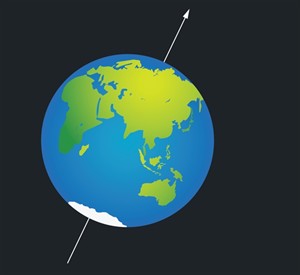
Earth's tilt
Activity: To demonstrate how the tilt of the Earth’s axis affects the intensity of sunlight and causes seasons.
Step 1: Hold one cardboard piece flat, perpendicular to the light from a lamp.
Step 2: Hold the second piece at a slant or tilt towards the lamp.
Step 3: Shine the lamp on both sheets and observe the area covered by light.
Step 4: Measure or compare the brightness or concentration on the flat versus tilted sheet.
Observation:
- The perpendicular sheet receives light over a smaller area, making it more intense, simulating summer in the hemisphere tilted toward the Sun.
- The tilted sheet spreads light over a larger area, making it less intense, simulating winter in the hemisphere tilted away from the Sun.
Conclusion:
This activity shows that the angle at which sunlight falls determines its intensity. The Earth’s tilt causes different hemispheres to receive more direct or slanted sunlight, explaining the seasonal changes.
The Earth’s axis is tilted about \(23.5°\) from the upright position relative to its orbit around the Sun, and this tilt remains constant as the Earth revolves. Because of this, the Sun’s rays do not fall equally on all parts of the Earth throughout the year, leading to seasonal changes.
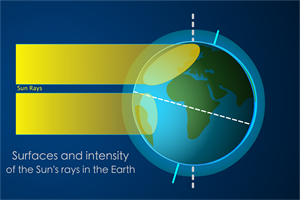
Intensity of Sun's rays on different hemispheres
Summer conditions in the Northern Hemisphere (June Position of the Earth):
In June, the Northern Hemisphere is tilted towards the Sun. As a result, the Sun’s rays fall more directly on this hemisphere and are concentrated over a smaller area, making the sunlight more intense. At the same time, the Southern Hemisphere is tilted away from the Sun, so the same amount of sunlight is spread over a larger area, making it less intense.
During this period, places in the Northern Hemisphere receive more than \(12\) hours of daylight, while places in the Southern Hemisphere experience shorter days. The North Pole receives sunlight for all \(24\) hours, leading to continuous daylight called polar day. The combined effect of higher intensity sunlight and longer daylight hours causes the summer season in the Northern Hemisphere.
Winter conditions in the Northern Hemisphere (December position of the Earth):
In December, the situation is exactly the opposite. The Southern Hemisphere is tilted towards the Sun and receives more direct and intense sunlight that are concentrated over a small area, while the Northern Hemisphere is tilted away from the Sun and receives slanting rays that are spread over a larger area and are therefore less intense.
Due to the Earth’s rotation, places in the Southern Hemisphere enjoy longer daylight hours, whereas the Northern Hemisphere has shorter days. During this time, the North Pole remains in complete darkness for \(24\) hours, experiencing what is known as the polar night.
These reduced daylight hours and weaker sunlight result in the winter season in the Northern Hemisphere. These variations in sunlight intensity and day length clearly explain how the Earth’s tilted axis and rotation cause seasons.
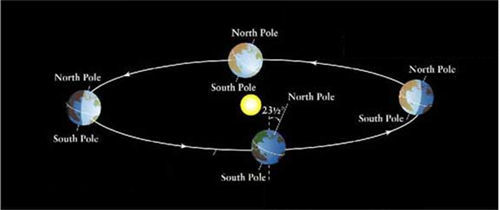
Summer and winter conditions in the hemispheres
Common misconceptions about the causes of seasons:
Two incorrect explanations are often given to explain why seasons occur on the Earth.
- One mistaken idea is that when the Northern Hemisphere tilts towards the Sun, the Earth is closer to the Sun.
- Another incorrect belief is that the Earth’s orbit is highly oval, with the Sun away from the centre, causing large changes in the Earth–Sun distance during the year.
In reality, the difference in the Earth–Sun distance in both these cases is very small and does not cause seasons. In fact, the Earth is closest to the Sun in January, when the Northern Hemisphere experiences winter. Seasons actually occur due to the tilt of the Earth’s axis and not because of changes in the distance from the Sun.
Solstices and equinoxes in the Northern Hemisphere:
In the Northern Hemisphere, the longest day and the shortest night occur around \(21\) June, a day known as the summer solstice.
After the summer solstice, the length of daylight gradually decreases, while the duration of night increases. The shortest day and the longest night occur around \(22\) December, which is called the winter solstice.
On about \(21\) March and \(23\) September, day and night are nearly equal, each lasting about \(12\) hours. These two days are known as the spring equinox and the autumn equinox, respectively, in the Northern Hemisphere.
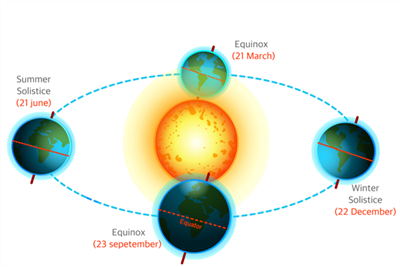
Solstices and equinoxes
Day and night at the Polar regions:
- At the North Pole, the Sun rises on \(21\) March and remains continuously above the horizon for about six months, resulting in uninterrupted daylight. The Sun sets around \(22\) September, after which the region experiences six months of continuous darkness.
- In contrast, at the South Pole, the pattern is exactly reversed. The Sun rises around \(22\) September and stays visible for the next six months, while it sets around \(21\) March, leading to a long period of darkness.
Thus, both polar regions experience six months of day and six months of night, but these periods occur at opposite times of the year. This phenomenon is very different from most other parts of the Earth, where day and night alternate every \(24\) hours due to the Earth’s rotation.
Seasonal conditions near the Equator:
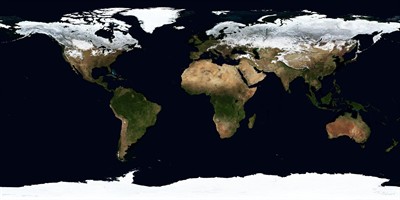
At the equator, the duration of day and night remains nearly equal, with about \(12\) hours of sunlight and \(12\) hours of darkness throughout the year. The intensity of the Sun’s rays falling on the equatorial region does not change much in different months. Because of this, the effect of seasons is less noticeable in regions close to the equator, such as the southern states of India.
In addition to latitude, other factors like local geographical features and proximity to oceans or seas also influence climate patterns. These factors can modify the general seasonal patterns observed in the Northern and Southern Hemispheres.
Seasonal conditions near the Equator