One afternoon, Juno noticed the Sun seemed partly hidden and asked his mother why. She explained, “That’s a solar eclipse. The Moon comes between the Sun and Earth, blocking its light for a short time.”
 
Amazed, Juno asked, “But the Moon is smaller than the Sun!”
 
His mother replied, “True, but it’s closer to us, so it can cover the Sun completely for a few minutes. That’s a total solar eclipse.”
 
Role of the Sun and blocking of sunlight: 
 
Many natural phenomena such as the day–night cycle, change of seasons, and life on Earth depend on the Sun. A question arises whether the sunlight reaching Earth can be blocked by planets that revolve between the Earth and the Sun. Mercury and Venus, though located between the Earth and the Sun, appear very small compared to the Sun and therefore cannot block its light completely. Interestingly, the Moon is capable of blocking sunlight. The Moon is the natural satellite of the Earth and revolves around it while the Earth revolves around the Sun.
 
Solar eclipse:
At certain times, the Moon moves between the Sun and the Earth in such a position that it blocks the sunlight from reaching the Earth. This phenomenon is called a solar eclipse.
pexels-yvon-gallant-81432586-21337460.jpg
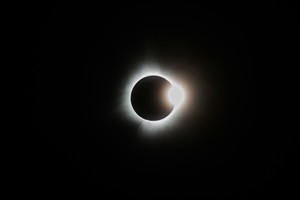
Diamond ring appearance in a Solar eclipse
 
Although the Moon is much smaller than the Sun, it can still block the sunlight we see from the Earth because of its relative position and distance from the Earth and the Sun.
 
Let us perform an activity to understand this relative position and apparent size better. 
Activity: To explore and understand about relative position and apparent size.
 
Step 1: Ask your friend to stand in front of you at a distance of about 5 metres and consider his head as the Sun.
Step 2: Close one eye and stretch your hand forward.
Step 3: Show a thumbs-up gesture towards your friend.
Step 4: Try to cover the entire head of your friend using your thumb.
 
Observation:
  • You will be able to cover the entire head of your friend with your thumb, even though your thumb is much smaller than your friend’s head.
  • This happens because the thumb is much closer to your eye than your friend.
  • The size of an object as seen by the eye, called its apparent size, depends on both its actual size and its distance from the observer.
Conclusion:
 
  • Objects that are closer to the eye appear larger than those that are farther away.
  • Similarly, the Moon and the Sun appear to be of nearly the same size when seen from the Earth.
  • Although the Moon is much smaller than the Sun, it is much closer to the Earth, which allows it to cover the entire Sun during a solar eclipse.
Transit of Venus and apparent size of planets:
 
Although the planets Mercury and Venus are much larger than the Moon, they are located much farther away from the Earth. Due to this greater distance, their apparent sizes are much smaller than that of the Sun, so they are unable to block sunlight completely. For instance, when Venus moves between the Sun and the Earth, it appears as a small black dot crossing the bright surface of the Sun. This rare phenomenon is known as the Transit of Venus.
 
Total Solar eclipse:
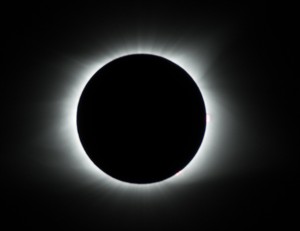
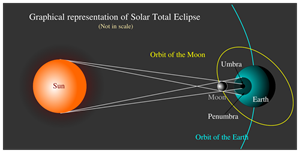
A total solar eclipse is a phenomenon in which the Moon comes between the Sun and the Earth in such a way that the Moon’s shadow falls on a small area of the Earth, causing complete darkness in that region and making the Sun completely invisible to observers there. 
eclipse-2695627_1280.jpg
Total solar eclipse
 
Duration of total Solar eclipse

Total solar eclipse causes daytime darkness in that region for a short duration, as no sunlight reaches the Earth. Due to the rotation of the Earth and the motion of the Moon in its orbit, the Moon’s shadow moves across the Earth, making the total solar eclipse visible only for a few minutes.
 
1200pxTotalSolarEclipseGraphicsEn01svgw1000.png 
Total solar eclipse
 
Partial Solar eclipse
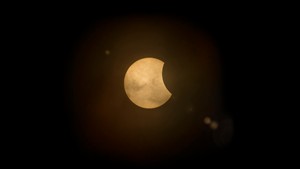
A partial solar eclipse occurs when the Moon comes between the Sun and the Earth and blocks only a part of the Sun. As a result, some sunlight still reaches the Earth, and observers can see only a portion of the Sun covered by the Moon. 
pexels-sebastian-566169.jpg
Partial solar eclipse
 
Safe viewing of a Solar eclipse: 
 
During a solar eclipse, people may feel tempted to look directly at the Sun, assuming that its light is not strong enough to harm the eyes. However, even during an eclipse, the Sun’s rays are powerful and can seriously damage the eyes or even cause blindness
 
Organised Solar eclipse viewing
 
During a solar eclipse, astronomy organisations such as planetaria and astronomy clubs often arrange special eclipse-viewing events. Participating in these programmes is the safest and best way to observe a solar eclipse. The organisers provide proper eye-protection equipment for safe viewing and also offer scientific explanations to help observers understand the phenomenon better.
 
Safe practices to observe a solar eclipse
  • Use solar eclipse glasses or certified solar filters to view the Sun.
  • Observe the Sun indirectly, for example, by projecting its image using a pinhole projector or a mirror setup.
  • Attend eclipse-viewing programmes organised by astronomy clubs or planetariums, where proper precautions are provided.
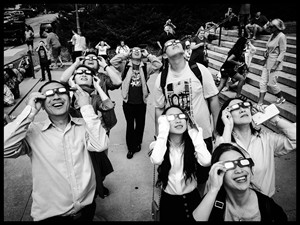
eclipse-2670215_1280.jpg 
People with solar eclipse glasses
 
Unsafe practices to observe a solar eclipse
  • Looking directly at the Sun with naked eyes, even during an eclipse.
  • Using regular sunglasses, binoculars, or telescopes without proper solar filters.
Safe method to project the Sun’s image: 
 
The image of the Sun can be projected onto a wall or screen using a mirror, but keeping the mirror at the correct angle for a long time can be difficult. To make this easier, a simple movable stand can be prepared by using a hollow ball with a small hole, half-filled with sand to make it stable, and fixing a small mirror on it. The ball can be placed on a circular ring so that it can be turned easily to adjust the mirror until the Sun’s image appears clearlyon the wall or screen.
 
Historical beliefs and scientific understanding of solar eclipses
 
Since ancient times, people have observed eclipses and kept records of them. In earlier days, when the causes of eclipses were not understood, people feared their occurrence, as the temporary blocking of the Sun, the main source of heat and light for Earth was considered alarming. As a result, many superstitions developed in different parts of the world, restricting activities such as eating, cooking, or going outside during an eclipse. Today, with scientific knowledge of how solar eclipses occur, there is no need to fear them, provided the Sun is not viewed directly. In fact, scientists travel to different parts of the world to observe eclipses, as these events allow them to study certain phenomena that cannot be observed at other times.
 
Eclipses in ancient Indian astronomy:
 
An eclipse is called grahan in Sanskrit and in several Indian languages. Many ancient Indian astronomical texts include detailed calculations used to predict eclipses. Among these, the Surya Siddhanta is one of the most well-known and widely referenced works, written in classical Sanskrit using rhythmic shlokas in poetic form.