

Let us step into our kitchen - not just as cooks - but, today, as science detectives! Well, let’s make a crispy and delicious dosa. Behind this dosa preparation, every step hides a bit of science magic! Ready to explore?
First, we take a pan and place it over the stove, and turn on the gas flame. But, wait, have you ever imagined where this flame comes from? It’s from LPG, a fuel is a mixture of hydrocarbons like propane and butane. They are non-metals.
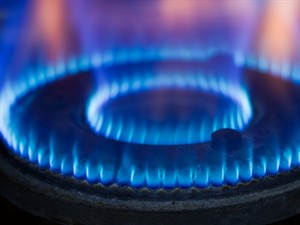
Burning of LPG gas burner
Once the pan heated up - did you know? The pan is made of iron, which is a shiny, solid metal that is hard and conducts. Once we spread the batter, it allows it to cook.
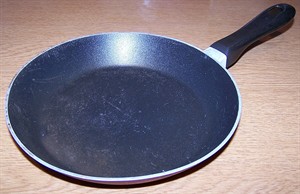
Frying pan
Imagine if the pan melts due to the heat produced by the gas flame! The pan does not melt because iron has a very high melting point. The gas flame temperature is much lower than iron’s melting point. Good heat conductivity helps spread heat evenly, but it does not prevent melting
Now it's time to serve the delicious dosa that we made out of science! We place it on a steel plate, which shines - another metal ready to carry our crispy dosa.
What did we learn as science detectives in the kitchen? From the pan to the plate, also from the fire to the food - our whole meal is a teamwork of metals and non-metals. Without which we couldn’t even boil water!
- Mostly metals are generally hard, shiny and good conductors of heat and electricity.
- Mostly non-metals may be solid, liquid or gas and are generally poor conductors.
Let’s learn about the metals and non-metals that we rely on in our daily lives.
Properties of materials
A physical property can be observed and measured without altering the sample's chemical identity. In other words, a physical property can cause a physical change but not a chemical change.
State:
i. Most metals are solid at room temperature, except mercury, which is liquid. Gallium melts just above room temperature.
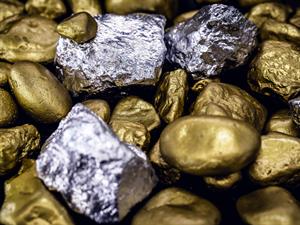
Gold and silver
ii. The non-metals naturally exist in three states: solid, liquid and gas.
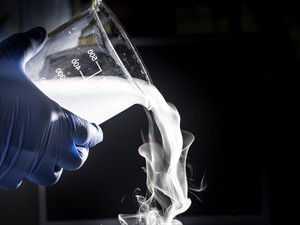
- Sulphur and phosphorus occur in a solid-state.
- Bromine occurs in a liquid state.
- Oxygen, nitrogen, hydrogen, halogens and noble gases occur in the gaseous state.
Chlorine gas
Lustre:
i. Metals are lustrous in nature. Metals have a shining surface in their purest form. This property is known as 'metallic lustre'. Metallic lustre means reflected light resembles a polished metal surface. For example, gold and silver.
Metals have free electrons that reflect light, making them appear shiny and giving them a metallic lustre.
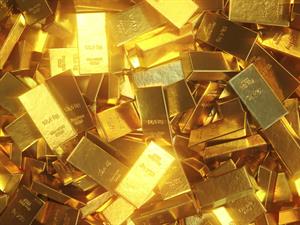
Gold
ii. Non-metals lack lustre because they have a dull appearance. Substances such as diamond (these are allotropes of carbon) and iodine are exceptions.
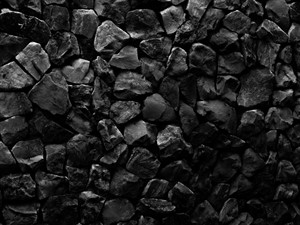
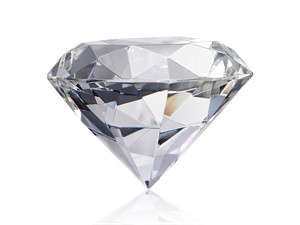
Carbon: non-lustrous; diamond: lustrous
Malleability:
Malleability refers to the ability of materials to be hammered or shaped permanently without breaking or cracking, allowing it to be beaten into thin sheets.
i. Metals are malleable. The most malleable metals are silver and gold. Aluminium is also malleable and can be beaten into thin sheets to create foils for wrapping food.
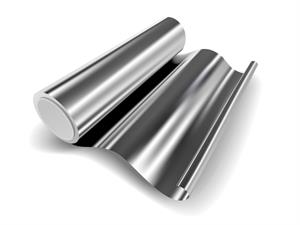
Thin sheet of metal
Activity: To determine the malleability of materials
Materials required:
- Hammer
- Iron material
- Charcoal
- Sulphur
- Copper
- Piece of aluminium
Instruction:
Place an iron material on a hard surface and beat it with a hammer. Repeat the same process for other materials. Observe the changes.
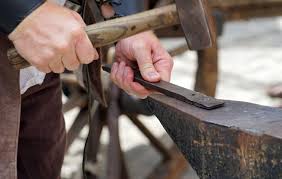
Hammering of an iron object
Observation:
You might have observed that certain materials exhibit different behaviour when hammered,
- Iron, copper, and aluminium can be flattened easily on hammering.
- In contrast, sulphur and charcoal do not flatten, instead they break into pieces, because they are brittle.
Most metals are hard; they can be beaten into thin sheets. However, some metals such as sodium, potassium and lithium are soft metals, and mercury is a liquid metal; hence they cannot be beaten into thin sheets..
ii. Non-metals are non-malleable. When non-metals are hammered, they form a powdery mass because they are brittle in nature.
Importance of malleability: The malleable nature of metals is useful for a wide range of applications,
- Aluminium is beaten into thin foil used for wrapping food.
- Gold and silver can be transformed into thin leaves and decorative foils.
- Copper for making coins.
- Manufacturing of thin sheets for cooking utensils, aircrafts, and automobiles
Hardness:
i. Metals are generally hard. The hardness varies from metal to metal. Take small pieces of iron, copper, aluminium or magnesium. Try to cut these metals with a sharp knife. You cannot cut them. On the other hand, alkali metals (lithium, sodium, potassium) are soft enough to be cut by a knife.
Activity 2:
- Take tiny pieces of iron, copper, aluminium and magnesium. Try cutting these metals with a sharp knife and take notes.
Answer: They are very difficult to cut.
- Using tongs, hold a piece of sodium metal.
Important!
Caution: Always handle sodium metal with care.
- Press it between the folds of a filter paper to dry. Try to cut it with a knife placing it on a watch glass. What do you notice?
Answer: Sodium is easily sliced with a knife.
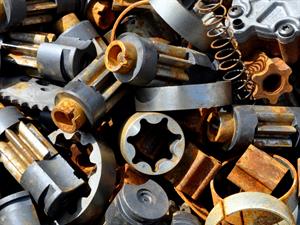
Hardness of metal
ii. Non-metals are soft and brittle. The hardest natural substance known is diamond, which is a carbon allotrope.
Ductility:
The property of materials that allows them to be pulled into thin wires is called ductility.
i. Most of the metals are ductile, and they can be drawn into thin wires. Gold is the most ductile metal. One gram of gold may produce a wire with a length of around \(2\) kilometres.
Metals can be moulded into various shapes according to our needs due to their malleability and ductility.
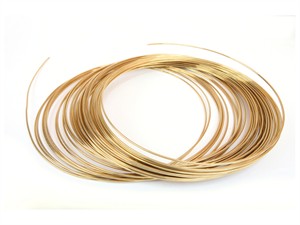
Thin wire of metal
ii. Non-metals are non-ductile. As they are brittle, they cannot be drawn into thin wires.
Importance of ductility: The ductile nature of metals promotes for a wide range of applications,
- Copper is used in electrical wiring.
- Gold and silver can be used for making jewellery.
- Cables for electronics and constructions.
- Aluminium wires used in power cables.
Reference:
https://1.bp.blogspot.com/-kpCdiNTyXf4/WMbnYWVLboI/AAAAAAAARQk/ih7_pQFGR-ckJDjRtkXVyVlbSx6Pv0jwgCLcB/s1600/CONDUCTINGINSULATINGWIRE.png
https://static.scientificamerican.com/sciam/cache/file/3C2E23FD-92A9-445C-B6277C77F4778B19_source.jpg?w=590&h=800&C44FB252-DC48-4E4C-BB7BF2A533AC63E1
https://02f0a56ef46d93f03c90-22ac5f107621879d5667e0d7ed595bdb.ssl.cf2.rackcdn.com/sites/5337/photos/231211/IMG_0896120160926-16535-1y7n49q_original.jpg
https://hi-static.z-dn.net/files/dfa/018fbfde06e00a73ac0a1cf719826930.jpg