

While your mother cooks in the kitchen, you can sense the delicious aroma coming to you even though you're in another room. Have you ever wondered how that smell came to you?
And, we all like balloons, right? But, have you ever wondered how the balloon seller fill those a large number of balloons in a short span of time? The answer is gases.

Gas characteristics
Gases are highly compressible as compared to solids and liquids. In the gaseous state, the particles move about randomly at high speed.
Because of this property, we can use the gases in LPG in highly compressed condition. If we compress the gas particles, we can store it in a small container too.
We know that gas particles have more freely movable particles, so it can travel through the air easily. That's why the aroma of a food reaches to you even though you're in a separate room.
Intermolecular force on gases:
The inter molecule force in the gaseous substance is weaker as compare to the liquid and solid. This weaker inter molecule force makes the gaseous matter to move freely in the air.
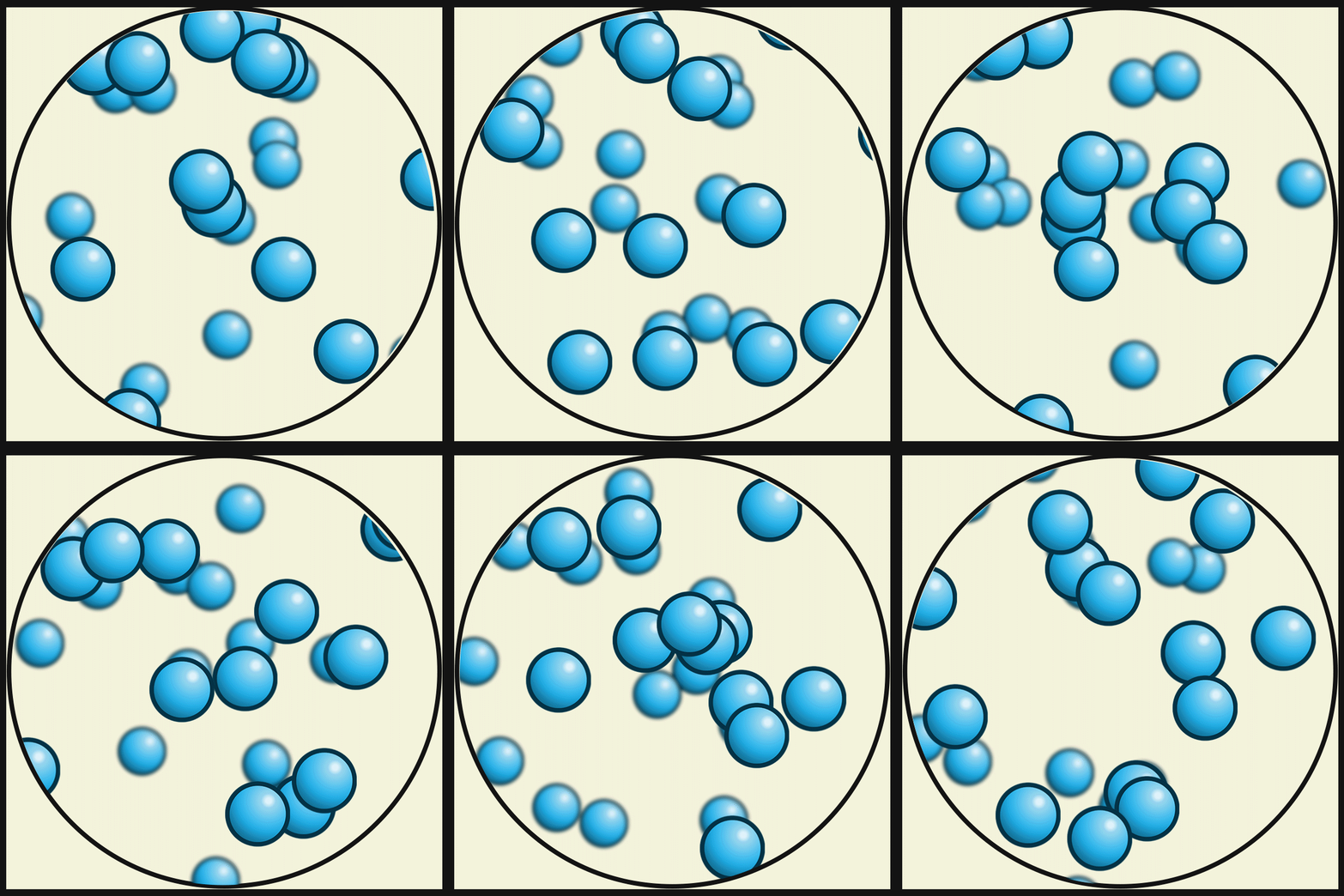
Interparticle spacing in gases
Transformation of states:
Have you ever wondered why ice turns into puddles of water on a sweltering day?
Knowing that matters can change its states; when a state change occurs, the properties of substances also change. Similarly, if the state change is reversed, the substance will recover the properties which it had before.
1. Melting / Fusion: When the temperature increases, solid particles gain energy and break their fixed positions to form a liquid.
2. Vaporisation: The process by which a liquid converts its physical state to a gaseous state is known as vaporisation.
3. Condensation: The process of a gas converting its physical state to a liquid state is known as condensation. This is also called reverse vaporisation.
4. Freezing/Solidification: On cooling, liquid particles lose energy, move slowly, and get tightly packed to form a solid.
5. Sublimation: Some solids directly change into a gas on heating because their particles get enough energy to overcome attraction.
6. Deposition: When gas cools rapidly, its particles lose energy and directly form a solid without becoming liquid.

Transformation of states of matter
The matter changes its state respective to the energy applied to it. The following figure explains how the matter changes its state wherever the energy is applied.

Transformations of states
This leads to the rearrangement to the substance because the attracting force no longer holds the particles tightly.
Boiling point:
The temperature at which a liquid begins to boil at atmospheric pressure is known as its boiling point.
Melting Point:
The temperature at which a solid substance melts to become a liquid at atmospheric pressure is called the melting point of that substance.
Reference:
https://commons.wikimedia.org/wiki/File:VW_Fingers_touching_water.jpg
By Julio Miguel A Enriquez and Monica Muñoz - Wiki Learing Tec de Monterrey