

Everything around us is made of matter. Matter exists mainly in three common physical states. But why does the same matter exist in different states? Why is ice hard, water able to flow, and steam able to spread everywhere?
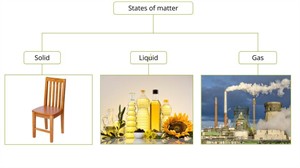
Physical states of matter
The answer lies in the way the tiny particles of matter are arranged and how strongly they attract one another. The physical state of a substance depends mainly on the force of attraction between its particles and the distance between them.
Constituent Particles:
Every substance is made up of extremely tiny particles called constituent particles. These particles may be atoms, molecules, or ions depending on the substance.
Even though matter appears continuous and solid to us, it is actually made up of millions of tiny particles joined together.
For example:
- A piece of chalk looks like one complete object, but when it is crushed, it breaks into smaller and smaller pieces. This shows it is made of tiny particles.
- Sugar dissolves in water and spreads throughout the solution, showing that its particles are very small.
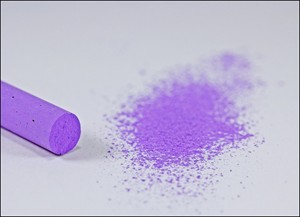
Constituent particles in chalk
These particles are not isolated; they stay together because there are forces acting between them. Without these attractive forces, matter would not remain as a substance.
Force of attraction between particles:
The particles of matter attract one another. This attractive force acting between particles is called the interparticle force of attraction. These forces are responsible for keeping particles together and maintaining the existence of matter.
Imagine trying to break a wooden stick. It requires force because the particles inside the wood are strongly attracted to one another. Similarly, when we pour water, the water particles still remain connected while flowing because some attraction still exists between them.

Flowing of water
Thus, the particles of matter are not loosely scattered; they remain together because of these attractive forces.
Nature of interparticle forces:
The force of attraction between particles is not equally strong in all substances. In some materials, the particles are held together very tightly, while in others they are held less strongly.
For example:
- The particles in a stone are held together very strongly.
- The particles in water are held together less strongly.
- The particles in air have very weak attraction.
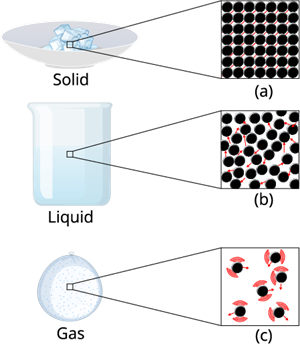
Interparticle force of attraction
A solid object remains rigid because its particles are strongly attracted. A liquid can flow because its particles experience weaker attraction. A gas spreads everywhere because its particles experience very little attraction. Thus, the strength of attraction between particles determines the properties of matter.
Interparticle distance:
The particles of matter are separated by spaces. The distance between two particles is called interparticle distance.
Different states of matter have different interparticle distances.
- In solids, particles are packed very closely.
- In liquids, particles are slightly farther apart.
- In gases, particles are very far apart.
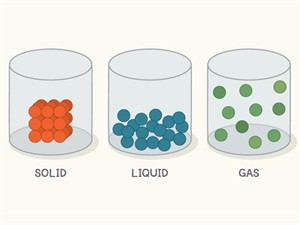
Interparticle spacing in different states if matter
This distance between particles is extremely important because the force of attraction depends on it.
Dependence of force of attraction on interparticle distance:
The force of attraction between particles changes with distance. When particles are very close to each other, the force of attraction becomes strong. When particles move farther apart, the force of attraction becomes weaker.
Therefore:
- Smaller interparticle distance → Stronger attraction
- Larger interparticle distance → Weaker attraction
Strength of attractive forces decides the physical state:
The physical state of a substance mainly depends on the strength of the attractive forces between its particles.
- Solids - Very strong interparticle attraction
- Liquids - Moderate interparticle attraction
- Gases - Weak interparticle attraction
Therefore, the arrangement, movement, and spacing of particles are controlled by the force of attraction between them.