

Diya was blowing air into a balloon for her sister’s birthday. The balloon became bigger and bigger, and suddenly it burst with a loud pop.
Why did the balloon burst?
As more air was blown in, the air pressure inside the balloon became much greater than the atmospheric pressure outside. When the rubber stretched beyond its elastic limit, it burst.
Pressure exerted by air:
Air is present all around us. The layer of air surrounding the Earth is called the atmosphere. It is made of gases like nitrogen, oxygen, carbon dioxide, and a few others. The atmosphere extends many kilometres above the Earth.
Air is made up of tiny particles called molecules. These molecules are constantly moving in all directions. When they collide with surfaces, they exert a force.
Air pressure is the force exerted by air per unit area of a surface.
The pressure variation near the ground level and above the ground level is depicted in the below diagram. Since the particles are closer to the ground, the pressure at the ground level will be higher, and the pressure above the ground level will be lower.
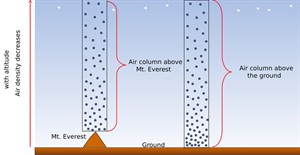
Variation of pressure
The air gets thinner when we move to a higher altitude. Therefore, the atmospheric pressure decreases as we go up in the mountains. But, on the other hand, the The air pressure increases as we go down below sea level, like mines.
Characteristics of air pressure:
- Air exerts pressure in all directions: The air pushes on objects from all directions such as upward, downward, and sideways.
- Air pressure acts on all objects: It acts on solids, liquids, and gases, including our bodies.
- Air pressure is caused by the continuous movement and collision of air molecules. Atmospheric pressure is mainly due to the weight of the air above us and the continuous collisions of air molecules.
Let us find out if the atmosphere exerts pressure by performing the following activity.
Activity: To observe the atmospheric pressure and the effect of area.

Newspaper spread on a ruler
Step 1: Place a ruler on the edge of a table so that most of its length projects out.
Step 2: Spread a newspaper flat on the portion of the ruler that is resting on the table.
Step 3: Hit the free end of the ruler sharply with your hand.
Step 4: Now fold the same newspaper into a smaller size and place it again over the ruler on the table.
Step 5: Hit the free end of the ruler in the same way.
Observation:
When the large sheet of paper was spread out, the ruler did not flip up easily.
When the sheet was folded to a smaller size, the ruler flipped up quickly when hit.
Conclusion:
The newspaper presses down on the ruler because of atmospheric pressure. When the newspaper covers a large area, the air pushes on it with a greater total force, so the ruler is held down firmly.
The newspaper presses down on the ruler because of atmospheric pressure. When the newspaper covers a large area, the air pushes on it with a greater total force, so the ruler is held down firmly.
Pressure is same, but total force depends on area. When the area is small, the force of air is less, so the ruler flips up easily. This shows that the force of air increases with area, and since pressure is force acting per unit area, we can conclude that air exerts pressure on all objects in all directions.
Atmospheric pressure:
The pressure exerted by the air column all around us in all direction, on the surface of the earth and on all objects, is called atmospheric pressure.
The SI unit of pressure is (\(N/m^2\)), also called a pascal (\(Pa\)).
In practice, air pressure is often measured in millibar (\(mb\)), where \(1\) millibar \(=\) \(100\) pascals. It can also be expressed in hectopascal (\(hPa\)), which is the same as \(100\) pascals.
Example:
- In syringes the liquid rises inside it when the piston is pulled, as outside air pressure pushes the liquid in.
- A balloon inflates because air blown inside exerts pressure on its walls.
- When drinking with a straw, juice rises in a straw because atmospheric pressure pushes the liquid up when we suck out air.
- Air pump of a cycle works because outside air pressure pushes air into the pump and then into the tyre.
- A rubber sucker pressed on a smooth surface sticks tightly because the air beneath it is forced out, creating a low pressure region inside. The outside air, which is at higher pressure, pushes the sucker against the surface. This proves that atmospheric air exerts pressure.
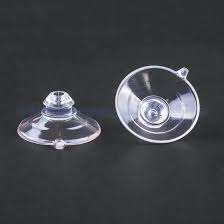
Rubber suckers
Activity:
To observe and understand the magnitude of atmospheric pressure.
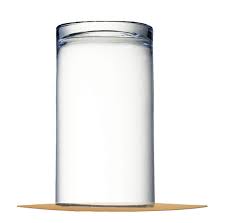
Upside down glass filled with water
Step 1: Fill a glass tumbler about three fourths with water.
Step 2: Place the cardboard over the mouth of the glass.
Step 3: Hold the cardboard firmly with the hand and quickly invert the glass.
Step 4: Now gently remove the hand from the cardboard.
Observation: The cardboard does not fall, and the water remains in the glass even though it is upside down.
Conclusion: The cardboard is held in place because atmospheric pressure from below is greater than the weight of the water above. This shows that air pressure can support objects against gravity.
Important!
We are not crushed by the weight of air because the pressure inside our body is equal to the atmospheric pressure outside. This balance prevents us from being pressed down. The pressure inside our body comes from the movement of fluids and gases in our tissues and organs.
Diya noticed that when she released the balloon without tying its mouth, the air rushed out quickly and made the balloon fly around the room.
Why did this happen?
It happened due to the pressure difference between the air inside the balloon and the air outside.
Activity: To observe and understand the difference in air pressure.
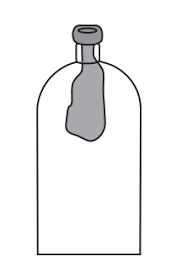
Balloon inside a bottle
Step 1: Take a balloon and stretch the mouth of the balloon over the neck of an empty bottle so that the balloon hangs inside.
Step 2: Try blowing air into the balloon while it is inside the bottle. You will find it very hard.
Step 3: Now make a small hole at the side of the bottle and again try blowing air into the balloon.
Observation:
- When the bottle is closed, the balloon does not inflate. But when a hole is made, the balloon inflates easily.
- A balloon inside a closed bottle does not inflate because the trapped air inside has no place to go and resists the air being blown in.
- When a hole is made in the bottle, the trapped air escapes, allowing the balloon to expand.
Conclusion: This shows that air can move and make space only when there is a way to escape. Air always goes from a place where there is more air (high pressure) to a place where there is less air (low pressure).
This pressure of air plays an important role in many natural processes such as winds, storms, and cyclones, which will be disucssed in the upcoming theories.