

Air always moves from a region of high pressure to a region of low pressure. This movement of air is what we feel as wind. Winds on Earth are caused by differences in air pressure in different regions of the atmosphere. Wind stops flowing between two regions when the pressure difference between them becomes zero.
Formation of sea breeze:
During the day, land heats up faster than water, so the air above land becomes warm, lighter, and rises, creating a low-pressure area. The cooler, heavier air over the sea is at higher pressure, so it moves in to replace the rising warm air above the land. This movement is called a sea breeze.
Formation of land breeze:
At night, the land cools down faster than water, so the air over land becomes cooler, heavier, and creates a high-pressure area, while the air over the sea remains warmer and lighter, forming a low-pressure area. As a result, air moves from land to sea, and this is called a land breeze.
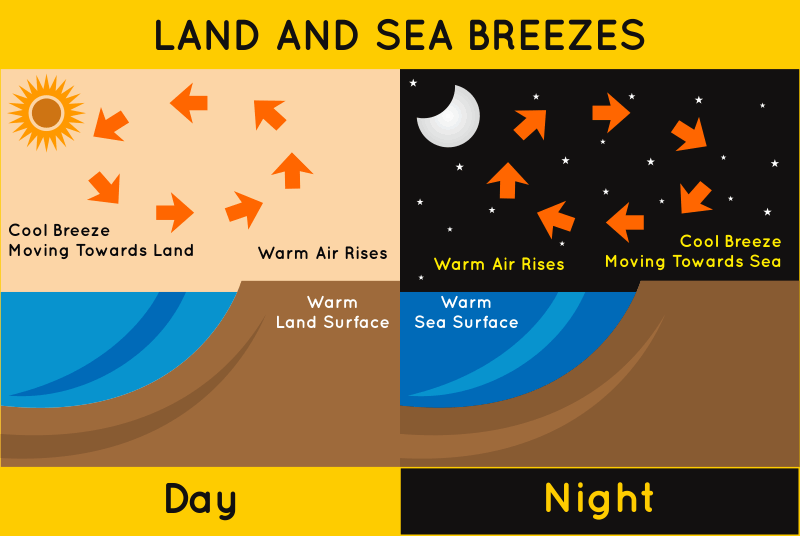
Land and sea breeze
Evaa was watching the news on TV in the evening. The reporter showed videos of strong winds bending trees, heavy rain pouring on the streets, and lightning lighting up the dark clouds, followed by loud thunder. Eva wondered what this natural event was called.
What natural event did Eva see on the news?
Eva saw a storm with high-speed winds and heavy rain. When lightning and thunder occur, it becomes a thunderstorm.
Let us understand high-speed winds with the help of an activity.
Activity: To observe how high-speed winds are accompanied by a reduced pressure.
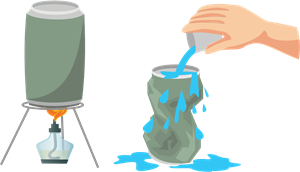
Tin cans
Step 1: Place the two empty tin cans side by side on the table, leaving a small gap of about 2cm between them.
Step 2: Blow air steadily into the gap between the two tin cans.
Step 3: Watch what happens.
Observation:
It is observed that instead of moving apart, the two cans roll towards each other.
It is observed that instead of moving apart, the two cans roll towards each other.
Conclusion:
Blowing air between the tin cans creates a low pressure area between them because it makes the air move faster in that region, lowering the pressure. The air on the outer sides is at higher pressure, so it pushes the cans towards each other. This shows that faster-moving air has lower pressure compared to surrounding still air.
Blowing air between the tin cans creates a low pressure area between them because it makes the air move faster in that region, lowering the pressure. The air on the outer sides is at higher pressure, so it pushes the cans towards each other. This shows that faster-moving air has lower pressure compared to surrounding still air.
High-speed wind:
High-speed wind is the rapid movement of air from a high-pressure area to a low-pressure area due to a large pressure difference. As the wind speed increases, the pressure it exerts decreases. This pressure difference makes air move faster. The speed of air (wind) is higher if the pressure difference is higher.
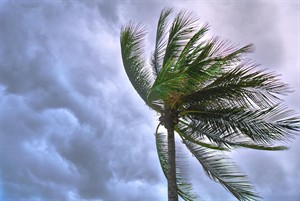
High speed wind blowing over a tree
i. Movement of balloons due to air pressure:
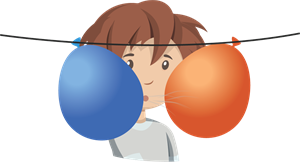
Blowing air between balloons
Instructions:
- Step 1: Two balloons of equal size are filled with little amount of water.
- Step 2: Then the balloons are blown, and the ends are tied with a string.
- Step 3: The balloons are hanged on a stick at 8–10 cm apart.
- Step 4: Now blow the air in the space between the balloons.
Observation: Instead of moving apart, the balloons move closer to each other when air is blown between them.
Explanation:
When you blow air between the balloons, the air in that region moves very fast. Fast-moving air exerts lower pressure compared to the surrounding still air. The air on the outer sides of the balloons has higher pressure, which pushes the balloons towards the lower-pressure region between them. As a result, the balloons move closer together.
Conclusion:
High-speed moving air results in lower air pressure, and objects tend to move towards regions of lower pressure.
ii. Hot air experiment:
Two paper bags or cups of the same size are taken and hanged on a wooden or metal stick. The paper bags (cups) are placed in an inverted position on the ends of a stick. A piece of thread is tied in the middle of the stick to hold it like a balance.
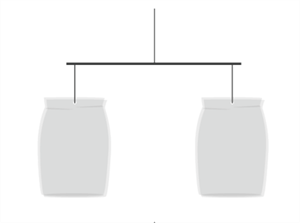
Paper bags hanged on a stick
A burning candle is kept under one of the bags (cups). It is noticed that the paper bag (cup) placed above the candle is pushed upwards. This is because the warm air being lighter rises and fills the space inside the bag.
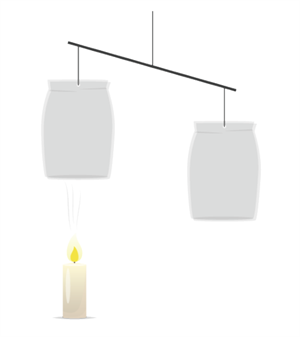
Warm air pushes the paper bag upwards
Therefore, the hot air rises and pushes the bag upward, disturbing the balance. From this experiment, it is evident that warm air rises. This concept is applied in the launching of hot air balloons.
Effect of high-speed winds on roofs:
- When strong winds blow over houses, they create low pressure above the roof.
- The air pressure inside the house is higher than the pressure outside.
- If the pressure difference is very large and the roof is weak, it can be blown away.
Why doors and windows should be kept open?
- If doors and windows are open, wind can pass through the house instead of only above it.
- This reduces the pressure difference between inside and outside.
- As a result, the chance of the roof blowing away is much less.