

Imagine standing on soft sand with flat shoes and then with pointed heels. In one case you will be stable; in the other, you sink. Even though your weight is the same, the effect changes. This happens because in solids, pressure depends not only on force but also on the area over which the force acts.

Pressure exerted by pointed heels
Pressure is defined as the force acting per unit area on a surface, provided the force is applied perpendicularly to that surface.
\({\text{Pressure}}\) \(=\) \(\frac{\text{Force}}{\text{Area}}\)
Mathematically,
\({\text{P}}\) \(=\) \(\frac{\text{F}}{\text{A}}\)
SI unit of pressur is Newton per square metre (\(N/m²\)), also called pascal (\(Pa\)).
Effect of area:
Pressure increases when the same force is applied over a smaller area and decreases when it is applied over a larger area. This is because pressure is inversely proportional to area.
\({\text{P}}\) ∝ \(\frac{\text{1}}{\text{A}}\) (For constant force)
Smaller area - higher pressure
Larger area - lower pressure
Examples:
- Camels can walk easily on desert sand because their broad feet spread their weight over a larger area, reducing pressure and preventing them from sinking.
- Tractors, bulldozers, and camels have broad tyres, which spread force over a large area and prevent sinking in soil, mud, or sand.
- Knives, nails, and needles have very small tips, so the force acts on a small area and creates high pressure, making cutting or piercing easy.
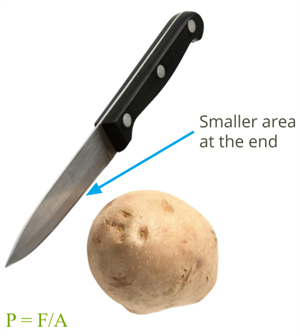
Pressure exerted by sharp knife
When a solid object is placed on a surface, it exerts pressure due to its weight. The pressure exerted depends on:
- The weight of the object (force)
- The area of contact with the surface
This explains:
- High-heeled shoes sink into soft ground more easily than flat shoes.
- Heavy vehicles are provided with wide tyres to reduce pressure on the road.
Pressure in liquids:
Even though liquids may appear to be at rest, they continuously exert pressure on the surfaces of the container and on any object in contact with them. This pressure arises due to the weight of the liquid acting under the influence of gravity.
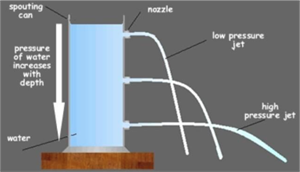
Kiran filled a bottle with water and there was a leak as there was a hole at the bottom of the bottle. Curious, he tried making another hole on the side of the bottle, and the water poured from that hole as well.
Why does this happen?
- Water exerts pressure in all directions not just downward but also sideways.
- That is why water comes out of the side of the bottle.
Liquids exert pressure in the depth:
i. Take a water bottle, and make three hole at equal depth of the bottle. Fill the bottle with water and note down the pressure. All the liquids exert the same pressure as shown in the below.
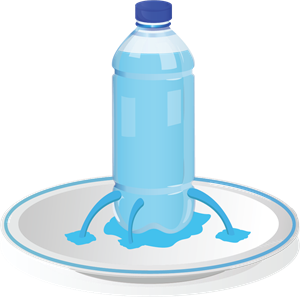
Pressure at same depth
ii. If the hole is made at different depths, the pressure will vary, resulting in unequal water flow. The flow of water is uneven. It shows the pressure depends on the height. The pressure will be more at the depth and less at the top.
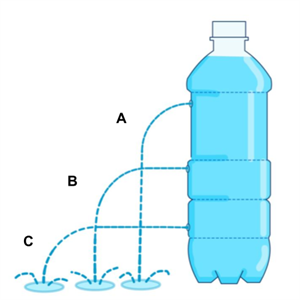
Unequal flow of water
Variation of pressure by density:
Take two different liquids of different densities to the same level in plastic containers. Consider oil in one container and water in other. Make holes in the two containers at the same level.
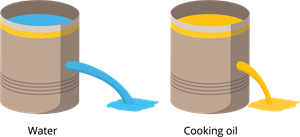
Flow of water and cooking oil
It can be seen that water is flowing out with more pressure than oil. This indicates that pressure depends on the density of the liquid.
Pressure exerted by air:
Air is made up of tiny particles called molecules. These molecules are constantly moving in all directions. When they collide with surfaces, they exert a force.
Air pressure is the force exerted by air per unit area of a surface.
The pressure variation near the ground level and above the ground level is depicted in the below diagram. Since the particles are closer to the ground, the pressure at the ground level will be higher, and the pressure above the ground level will be lower.
Characteristics of air pressure:
- Air exerts pressure in all directions: The air pushes on objects from all directions such as upward, downward, and sideways.
- Air pressure acts on all objects: It acts on solids, liquids, and gases, including our bodies.
- Air pressure is caused by the continuous movement and collision of air molecules. Atmospheric pressure is mainly due to the weight of the air above us and the continuous collisions of air molecules.
Atmospheric pressure:
The pressure exerted by the air column all around us in all direction, on the surface of the earth and on all objects, is called atmospheric pressure.
The SI unit of pressure is (\(N/m^2\)), also called a pascal (\(Pa\)).
In practice, air pressure is often measured in millibar (\(mb\)), where \(1\) millibar \(=\) \(100\) pascals. It can also be expressed in hectopascal (\(hPa\)), which is the same as \(100\) pascals.
Activity:
To observe and understand the magnitude of atmospheric pressure.
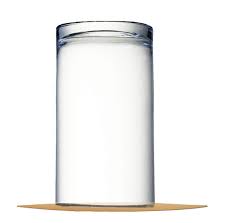
Upside down glass filled with water
Step 1: Fill a glass tumbler about three fourths with water.
Step 2: Place the cardboard over the mouth of the glass.
Step 3: Hold the cardboard firmly with the hand and quickly invert the glass.
Step 4: Now gently remove the hand from the cardboard.
Observation: The cardboard does not fall, and the water remains in the glass even though it is upside down.
Conclusion: The cardboard is held in place because atmospheric pressure from below is greater than the weight of the water above. This shows that air pressure can support objects against gravity.