

When Ethan returned home, he went into the bathroom to wash his feet. The moment he opened the tap, water gushed out quickly as the overhead tank was full. Later, when he filled a glass from the drinking water purifier, the water came out slowly.
Why did this happen?
- The bathroom tap receives water directly from the overhead tank, which is placed at a height.
- The greater the height of the water column, greater the water pressure at the tap. That is why water flows out quickly in the bathroom.
- The drinking water purifier, on the other hand, is usually placed at a lower level.
- Since the height of water above its tap is small, the pressure is less, and the water flows out slowly.
Water pressure increases with height. This is the reason why water tanks are always placed at a height.
Pressure in liquids:
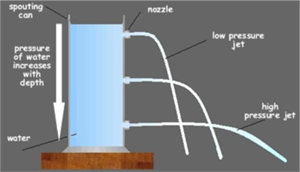
Activity: To observe that the pressure exerted by the liquid column increases with height.
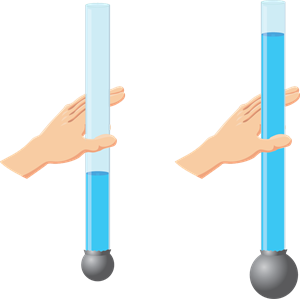
Variation of pressure
Step 1: Take four drinking straws, two of equal length but different diameters, and two of equal diameter but different lengths.
Step 2: Tie a small balloon tightly to one end of each straw so the opening is sealed.
Step 3: Hold the straws vertically with the balloon at the bottom.
Step 4: In the first setup of equal length but different diameters, fill both the straws with water and observe the size of both balloons.
Step 5: In the second setup of same diameter but different lengths, fill both the straws to the top with water and observe the size of both balloons.
Observation: In the first setup of equal length but different diameters, both balloons bulge equally, showing that liquid pressure does not depend on the area of cross-section or the weight of water.
In the second setup of same diameter but different lengths, the balloon attached to the longer straw bulges more, showing that liquid pressure increases with the height of the liquid column.
Conclusion: Liquid pressure depends on the height of the liquid column and not on the size or the weight of water.
The next day, while playing , Ethan filled a bottle with water and there was a leak as there was a hole at the bottom of the bottle. Curious, he tried making another hole on the side of the bottle, and the water poured from that hole as well.
Why does this happen?
- Water exerts pressure in all directions not just downward but also sideways.
- That is why water comes out of the side of the bottle.
Liquids exert pressure in the depth:
i. Take a water bottle, and make three hole at equal depth of the bottle. Fill the bottle with water and note down the pressure. All the liquids exert the same pressure as shown in the below.
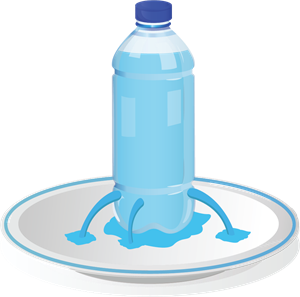
Pressure at same depth
ii. If the hole is made at different depths, the pressure will vary, resulting in unequal water flow. The flow of water is uneven. It shows the pressure depends on the height. The pressure will be more at the depth and less at the top.
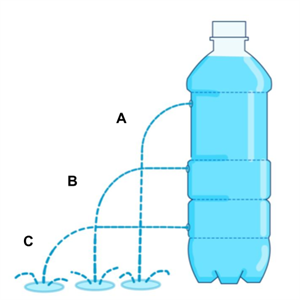
Unequal flow of water
Variation of pressure by density:
Take two different liquids of different densities to the same level in plastic containers. Consider oil in one container and water in other. Make holes in the two containers at the same level.
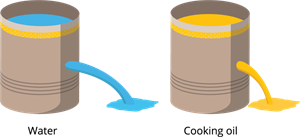
Flow of water and cooking oil
It can be seen that water is flowing out with more pressure than oil. This indicates that pressure depends on the density of the liquid.
Important!
Did you know the base of a dam is made much broader than the top?
This is because the base has to support the whole structure and also bear the strong water pressure at the bottom. Water stored in a dam pushes not only downward on the floor but also sideways on the walls. Since pressure increases with depth, the sideways pressure is greatest near the bottom. That’s why the base of the dam is built broader and stronger.