

On a warm evening, Emily and her twin brother Ethan went for a walk along the sandy beach. Emily wore her high-heeled sandals, while Ethan wore his wide, flat flip-flops. After only a few steps, Emily's heeled sandals started to sink deep into the soft sand. Each time she tried to lift her foot, the sand gripped her heel, making it hard to walk. But Ethan walked easily on his flip-flops.
Why did this happen?
- Both twins weigh about the same, so the force (weight) acting on the sand is nearly equal.
- But the area of contact where that force is applied is not equal.
Emily’s high heels:
- The pointed tips of the heels touch only a small area of sand.
- The same body weight (force) is concentrated on this small area, producing high pressure.
- High pressure means the sand under each heel is pressed down strongly, so the heels sink deep.
Ethan’s flip-flops:
- The broad soles touch a much wider area of sand.
- The same body weight (force) is spread over this large area, creating low pressure.
- Low pressure means the sand is pressed down lightly, so his feet stay on top of the sand.
Pressure:
Pressure is defined as the force acting per unit area on a surface, provided the force is applied perpendicularly to that surface.
\({\text{Pressure}}\) \(=\) \(\frac{\text{Force}}{\text{Area}}\)
Mathematically,
\({\text{P}}\) \(=\) \(\frac{\text{F}}{\text{A}}\)
SI unit of pressur is Newton per square metre (\(N/m²\)), also called pascal (\(Pa\)).
Effect of area:
Pressure increases when the same force is applied over a smaller area and decreases when it is applied over a larger area. This is because pressure is inversely proportional to area.
\({\text{P}}\) ∝ \(\frac{\text{1}}{\text{A}}\) (For constant force)
Smaller area - higher pressure
Larger area - lower pressure
Examples:
- A porter carrying a heavy load uses a broad cloth or pad on the head. The cloth increases the area of contact and reduces pressure on the head.
- Camels can walk easily on desert sand because their broad feet spread their weight over a larger area, reducing pressure and preventing them from sinking.
- Tractors, bulldozers, and camels have broad tyres, which spread force over a large area and prevent sinking in soil, mud, or sand.
- Knives, nails, and needles have very small tips, so the force acts on a small area and creates high pressure, making cutting or piercing easy.
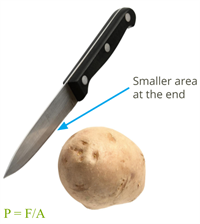
Sharp knife
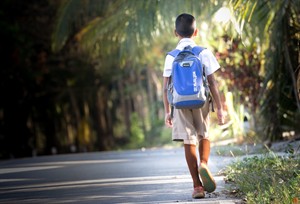
School bag with a broad strap for shoulder
Activity: To observe how pressure depends on the area of contact.
Step 1: Take a pencil with a sharp tip and a flat back.
Step 2: Keep a piece of thermocol on the table.
Step 3: Press the sharp tip of the pencil onto the thermocol.
Step 4: Now press the flat back side of the pencil with the same force.
Observation:
The sharp tip easily goes into the thermocol, but the flat back hardly makes any mark.
The sharp tip easily goes into the thermocol, but the flat back hardly makes any mark.
Conclusion:
When the area of contact is smaller (sharp tip), the pressure is higher even with the same force. When the area is larger (flat back), the pressure is lower.
When the area of contact is smaller (sharp tip), the pressure is higher even with the same force. When the area is larger (flat back), the pressure is lower.
Thus, when a solid object is placed on a surface, it exerts pressure due to its weight. The pressure exerted depends on:
- The weight of the object (force)
- The area of contact with the surface
This explains:
- High-heeled shoes sink into soft ground more easily than flat shoes.
- Heavy vehicles are provided with wide tyres to reduce pressure on the road.