

Every moment, an invisible force is acting all around us. It pushes on our bodies, books, tables, walls, and even the air around us. Yet, we hardly notice it! This force is called pressure. From a sharp needle piercing cloth to huge dams holding back water, pressure plays an important role in our daily lives. Let us explore this fascinating concept and understand how it influences winds, storms, and many other natural phenomena.
i. Pressure in solids:
Pressure is defined as the force acting per unit area on a surface, provided the force is applied perpendicularly to that surface. SI unit of pressur is Newton per square metre (\(N/m²\)), also called pascal (\(Pa\)).
\({\text{Pressure}}\) \(=\) \(\frac{\text{Force}}{\text{Area}}\)
Mathematically,
\({\text{P}}\) \(=\) \(\frac{\text{F}}{\text{A}}\)
When a solid object is placed on a surface, it exerts pressure due to its weight. The pressure exerted depends on:
- The weight of the object (force)
- The area of contact with the surface
ii. Pressure in liquids:
Characteristics of liquid pressure:
- Pressure increases with depth
- Pressure acts at the sides of the container
- Pressure is dependent on density and gravity
iii. Pressure exerted by air:
The pressure exerted by the air column all around us in all direction, on the surface of the earth and on all objects, is called atmospheric pressure. The SI unit of pressure is (\(N/m^2\)), also called a pascal (\(Pa\)).
Formation of sea breeze:
During the day, land heats up faster than water, so the air above land becomes warm, lighter, and rises, creating a low-pressure area. The cooler, heavier air over the sea is at higher pressure, so it moves in to replace the rising warm air above the land. This movement is called a sea breeze.
Formation of land breeze:
At night, the land cools down faster than water, so the air over land becomes cooler, heavier, and creates a high-pressure area, while the air over the sea remains warmer and lighter, forming a low-pressure area. As a result, air moves from land to sea, and this is called a land breeze.
High speed wind:
High-speed wind is the rapid movement of air from a high-pressure area to a low-pressure area due to a large pressure difference. As the wind speed increases, the pressure it exerts decreases. This pressure difference makes air move faster. The speed of air (wind) is higher if the pressure difference is higher.
Lightning formation:
- When the bottom of the cloud which has negative charges comes close to the ground, it makes the ground and objects positively charged.
- Normally, air stops charges from meeting by acting as an insulator.
- But when the charge difference becomes very high, the air breaks down.
Lightning is a bright flash in the sky caused when opposite electric charges quickly come together and meet, releasing energy. Lightning may occur within a cloud, between clouds, or between cloud and ground.
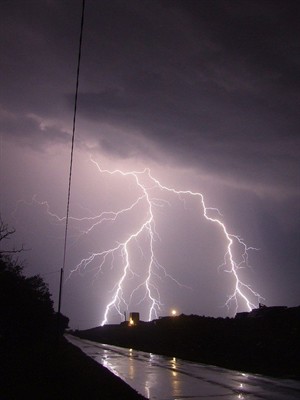
Lightning
Thunderstorm:
Lightning heats the air around it very quickly. The air expands suddenly, creating a loud sound called thunder. A storm with lightning and thunder is called a thunderstorm.
Cyclone:
A cyclone is a large spinning storm of clouds, strong winds, and heavy rain. It develops over warm ocean waters around a centre of very low pressure, called the eye of the cyclone.
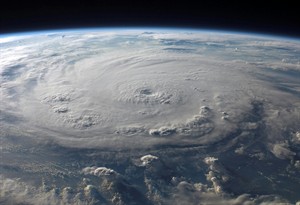
Cyclone
The centre of a cyclone is called the eye. The eye has the lowest pressure but calm weather. Around the eye, there are very strong winds and heavy rain.
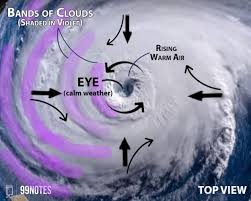
Eye of the cyclone