

High-speed winds during storms are often accompanied by thunder and lightning. These natural events occur together and make storms more dangerous.
Wind circulation and storms:
- When land gets heated, the warm and moist air rises because it is lighter.This creates a low pressure area.
- Cooler air from nearby high pressure areas rushes in to fill the space and this air becomes heated and rises.
- This cycle continues, causing wind circulation.
- As rising air expands, it cools, and moisture condenses into water droplets, forming clouds.
- Water droplets join to form bigger drops, which fall as rain, hail, or snow.
- Strong winds with rain are called a storm.
- In hot and humid regions like India, storms happen more often.
How charges form in clouds?
- Sometimes, warm air rises very high where it is colder.
- Water droplets freeze into ice particles.
- Strong upward and downward winds make droplets and ice rub and collide together.
- Rubbing causes static charges to build up like rubbing objects.
- Light ice particles become positively charged and move up.
- Heavier water droplets become negatively charged and stay lower.
- This separates charges inside the cloud.
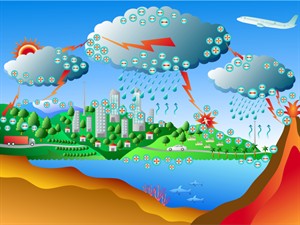
Clouds bringing rain
Lightning formation:
- When the bottom of the cloud which has negative charges comes close to the ground, it makes the ground and objects positively charged.
- Normally, air stops charges from meeting by acting as an insulator.
- But when the charge difference becomes very high, the air breaks down.
Lightning:
Lightning is a bright flash in the sky caused when opposite electric charges quickly come together and meet, releasing energy. Lightning may occur within a cloud, between clouds, or between cloud and ground.
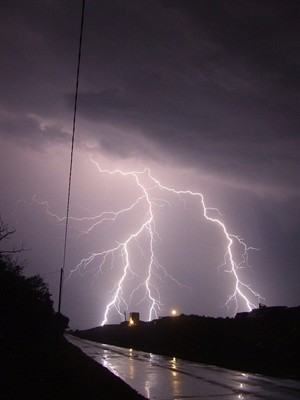
Lightning
Thunder:
Lightning heats the air around it very quickly. The air expands suddenly, creating a loud sound called thunder. A storm with lightning and thunder is called a thunderstorm.
Dangers of lightning:
- Lightning can cause fires, damage buildings, and harm people and animals.
- It can result in severe burns or even death.
Safety during lightning:
- Stay away from tall objects like trees.
- Do not go near electric poles or touch electrical wires or equipment during lightning.
- If you are in a low, open area, crouch down but do not lie flat.
- Avoid umbrellas with metal rods.
- If in water, get out immediately.
- If inside a bus, car or any building, you are safer.
Lightning conductor:
A lightning conductor is a metal rod fixed to a building while it is being constructed. The rod has a pointed end that is kept higher than the top of the building, and its other end is buried deep in the ground. When lightning strikes, the rod gives the electric charges a safe and easy path to travel into the ground, protecting the building from damage.
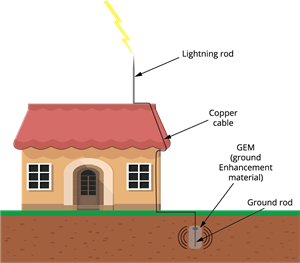
Lightning arrester
Important!
- We see lightning first and hear thunder later because light travels much faster than sound.
- Light from the lightning reaches our eyes almost instantly.
- But sound of thunder takes more time to travel through air, so we hear it after the flash.
In December, Diya was in Chennai when a cyclone from the Bay of Bengal struck. Heavy rain and strong winds flooded the streets, power went out, and people rushed to safety. Boats rescued families, and relief workers provided food and water.
After experiencing the heavy rain, strong winds, and floods in Chennai, Diya wondered: “What exactly is a cyclone and how does it form?”
What is a Cyclone?
A cyclone is a large spinning storm of clouds, strong winds, and heavy rain. It develops over warm ocean waters around a centre of very low pressure, called the eye of the cyclone.
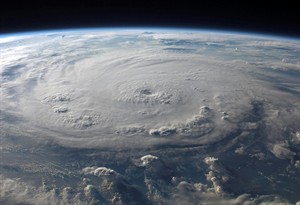
Cyclone
How cyclones form?
-
When the sun heats ocean water, some of it evaporates, turning into water vapour.
-
This warm, moist air rises upward because it is lighter.
-
As the air rises higher, the water vapour condenses into raindrops, releasing heat back into the atmosphere.
-
This released heat makes the air even warmer, so it rises further, creating a low pressure area.
-
Surrounding air rushes in to fill this low pressure, and it also rises.
-
The Earth’s rotation makes these winds start spinning around the low pressure centre.
-
This cycle repeats again and again, building up into a powerful spinning storm called a cyclone.
Eye of the cyclone:
The centre of a cyclone is called the eye. The eye has the lowest pressure but calm weather. Around the eye, there are very strong winds and heavy rain.
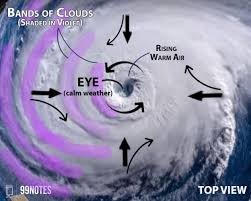
Eye of the cyclone
Strength of cyclones:
-
Cyclones are much stronger than normal thunderstorms.
-
As long as they are over the sea, they stay strong because they get moist air.
-
Once they move onto land, they lose strength since the source of moist air is cut off.
-
Even after weakening, they can still cause great damage.
-
Strong winds can reach speeds of more than \(200\) \(km/h\).
-
Winds push ocean water towards the coast, creating a storm surge (a wall of water \(3\)–\(12\) \(m\) high).
-
Storm surges flood coastal areas, sometimes even far inland.
-
Heavy rainfall can cause rivers to overflow and trigger landslides.
-
Seawater entering fields can damage crops and make soil salty, reducing fertility.
-
Drinking water sources may get contaminated.
-
Roads can be blocked by fallen trees and debris.
-
Power and communication lines may be damaged, disrupting daily life.
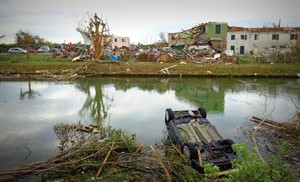
Destruction caused by a cyclone
Example:
Cyclone Amphan (\(2020\)) had peak winds of \(270\) \(km/h\), causing massive destruction.
Protection from cyclones:
-
Stay updated with weather reports and warning issued by the India Meteorological Department (IMD).
-
Use information from satellites to track cyclone paths.
-
Keep an emergency kit ready if you live in a cyclone-prone area.
-
During a cyclone, move to a designated cyclone shelter.
-
National and international organisations work together to reduce cyclone damage.
Names of cyclones:
Cyclones have different names in different parts of the world. In the Indian ocean (Bay of Bengal and Arabian Sea), they are called cyclones. In the Atlantic ocean and Eastern Pacific ocean (near the USA and Caribbean), they are called hurricanes. In the Western Pacific ocean (near Japan, Philippines, and China), they are called typhoons. In Australia, they are called willy-willies.
Reference:
https://insides.home.blog/wp-content/uploads/2019/05/screenshot-15.png