

Everyone might have looked at the mirror, glanced at the looks, and admired. Did we ever imagine what truly forms a human body? A closer look reveals a fascinating reality that it is not just made of skin and bones. But it is a collection of billions of tiny particles that are consistently interacting and moving.

A butterfly
Surprisingly, a butterfly resting on a flower may appear soft and fragile, but it is made of matter, just like a stone. From its wings to its body, it consists of billions of tiny particles.
Everything in this universe is made of matter. The study of the nature of matter explores how these tiny, invisible particles combine to form the things around us. It reveals the secret behind our world and ourselves.
Nature of matter:
Matter contains \(n\) number of particles. The particles of matter are very tiny, which is beyond our imagination. The particles of matter has mass and occupies space. Matter is made up of atoms, which combine to form molecules and substances.
An atom is the smallest particle that cannot be seen with the naked eye, even with standard microscopes. Modern science has introduced technologies for identifying the structure of atoms, with SEM (Scanning Electron Microscope) and TEM (Transmission Electron Microscope), which use electrical signals to map atomic structure.
An atom is made up of neutrons, electrons, and protons, in which neutrons and protons are present in the nucleus of the atom, while the electrons occupy various energy levels in the regions outside the nucleus.
Activity: Breaking chalk into smaller particles
Step 1: Take a piece of chalk and break it into two halves.
Step 2: Continue breaking the chalk into smaller and smaller pieces until it becomes hard to break with hand.
Step 3: Now, collect the smaller pieces and grind them using a mortar and pestle to obtain a fine powder.
Step 4: Observe the fine chalk powder using a magnifying glass.
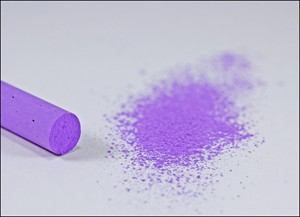
Chalk piece and ground chalk powder
The specks of chalk powder can be ground further into even tinier particles. The grinding process continues, and reaches a stage where the chalk particles cannot be broken down further.
These tiny units of chalk are the basic building blocks of a whole piece of chalk, which is composed of a large number of smaller units. These smaller units are called the constituent particles. Each tiny particle still retains the properties of the chalk.
A constituent particle is the basic unit (smallest unit) that makes up a larger piece of a substance or a material. All matter around us is made up of extremely tiny particles called constituent particles. Though the constituent particles are very small, they retain the properties of the substance they combine to form.
Activity: Dissolving sugar in water
- Take a clean glass tumbler and fill it with drinking water.
- Add two spoons of sugar into the water without stirring.
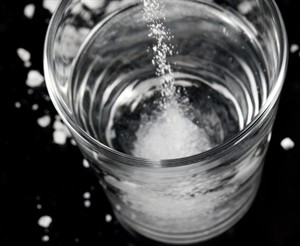
Sugar in water
- Taste a small amount of water from the top layer and observe its taste.
- Now stir the water until the sugar dissolves completely, then taste the water from the top layer and observe its taste.
Observation:
Before stirring, the top layer of water does not taste sweet. After stirring, the top layer of water tastes sweet.
Conclusion:
Sugar dissolves completely in water and seems to disappear. But the water tastes sweet, proving that the constituent particles of sugar spread uniformly throughout and occupy the available spaces between the particles of water without losing their properties. These spaces between the particles are known as interparticle spaces.
Characteristics of particles of matter:
The characteristics of particles of matter are as follows:
i. Particles of matter have spacebetween them.
ii. Particles in a matter are continuously moving.
iii. Particles of matter attract each other.
1. Particles of matter have space between them:
Take a beaker of water and add some salt. Stir the mixture using a glass rod until the salt dissolves completely. Observe the level of water in the beaker; it is not raised.
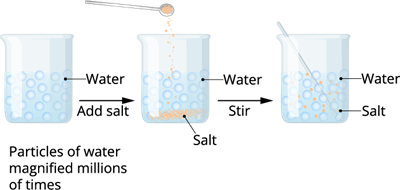
Dissolving salt in water
The particles of matter are very tiny in nature. When salt is dissolved in water, its particles occupy the spaces between the particles of water. This proves that there is space between the particles of matter. Similarly, when making lemonade, tea or coffee, the same principle is applies.
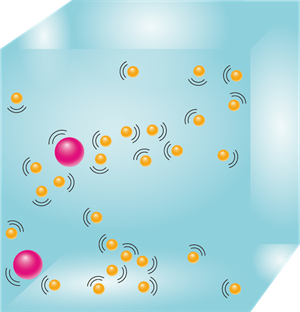
Spacing in particles of water
2. Particles in the matter are continuously moving:
The particles of matter are always in continuous motion. To understand this concept, let us perform a simple experiment.
- Step 1: Take a transparent glass filled with water.
- Step 2: Add a drop of red ink along the sides of the bowl. Leave the glass undisturbed for a few minutes and observe the change.
The ink begins to spread throughout the water, proving that the particles in matter are continuously moving.

Red ink spreading in water
The movement of particles is dependent on temperature. The kinetic energy of the particles increases with increasing temperature.
i. When the temperature increases, particles gain more energy and move faster.
ii. When the temperature decreases, particles lose energy and move slowler.
i. When the temperature increases, particles gain more energy and move faster.
ii. When the temperature decreases, particles lose energy and move slowler.
3. Particles of matter attract each other:
The particles of matter attract each other due to the various forces acting between them. These forces hold the particles together. The strength of the forces of attraction varies from one type of matter to another.
Different states of matter:
The constituent particles of matter are held together by attractive forces known as interparticle attraction. The strength of interparticle attractions depends on the nature of the substance; it varies from one substance to another.
It depends on the distance between the particles. Even a slight increase in the distance drastically decreases the interparticle forces. The strength of these attractive forces plays a crucial role in determining the physical state of matter.
Generally, matter can be classified into three types:
Generally, matter can be classified into three types:
- Solid - Strong interparticle force
- Liquid - Moderate interparticle force
- Gaseous - Weak interparticle force
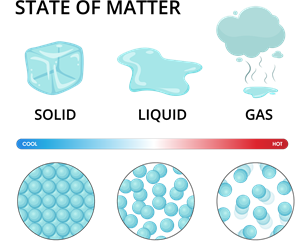
States of matter
Reference:
https://commons.wikimedia.org/wiki/File:Blue_tiger_butterfly.jpg
https://www.flickr.com/photos/sue90ca/8452216782