

When a juice bottle has a volume of \(500\ mL\) in its packaging, it means the space occupied by the juice inside the bottle is \(500\) millilitres.
In other words, the volume occupied by the fruit juice is \(500\ mL\).
Liquids do not have any definite shape. But it takes the form or shape of the container it is stored in. So, even though liquids have definite volume, it is not easily determined, unlike solids.
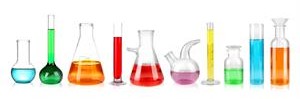
Liquid adapts the shape of the container
Volume is the measure of the amount of space occupied by an object. The SI unit of volume is cubic metre (\(m^3\)).
Volume is the measurement of three-dimensional space occupied by an object. Volume of smaller objects is expressed as decimetre (\(dm^3\)) or centimetre cube (cc) (\(cm^3\)).
The volume of an object can be determined from the density formula by dividing the mass of an object by its density.
Unit to measure the volume of liquid:
A \(litre\) (\(L\)) is a unit of measurement used to express the volume of liquid. For example, \(2\ litre\) oil packet, \(20\ litres\) water bottle and so on. Other units are \(millilitre\) (\(mL\)), \(centilitre\) (\(cL\)), and \(kilolitre\) (\(kL\)).
The readings in the measuring beakers are usually marked in units of a \(millilitre\) (\(mL\)). In terms of a \(millilitre\),
- \(1\ L\) \(=\) \(1000\ mL\)
- \(1\ mL\) \(=\) \(0.001\ L\)
- \(1 mL\) \(=\) \(1\ cm^3\)
One \(litre\) (\(L\)) is equal to the volume of \(1000\ cc\).
\(1\ L\) \(=\) \(1000\ cc\) (or) \(cm^3\)
Liquids can be measured in \(litres\) and can also be expressed in \(cubic\) \(metre\) or \(m^3\).
Measuring tools:
A liquid can be poured into a graduated container to determine its exact volume easily. There are various measuring tools to find the volume of a liquid. Some of them are,
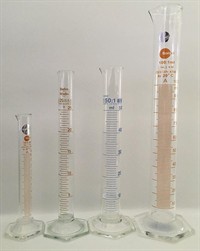
Measuring cylinders
A measuring cylinder is one of the common apparatus used to measure the volume of liquids. It is a narrow, cylindrical and transparent container. It has graduated markings to indicate the volume of liquid.
Measuring cylinders are available in different capacities, such as \(10\ mL\), \(20\ mL\). \(50\ mL\), \(100\ mL\), \(200\ mL\), \(250\ mL\), and \(500\ mL\)
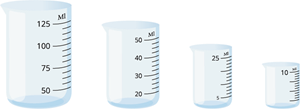
Beakers
The capacity of these containers is determined by the maximum volume of liquid they hold.
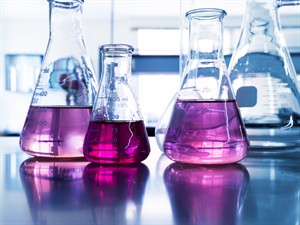
Conical flask
The volume of a liquid is the amount of space it occupies in a container. Therefore, the readings marked on the measuring containers directly indicate the volume of liquid.
Activity: To determine the volume of liquid in a measuring cylinder
Take a measuring cylinder and observe it.
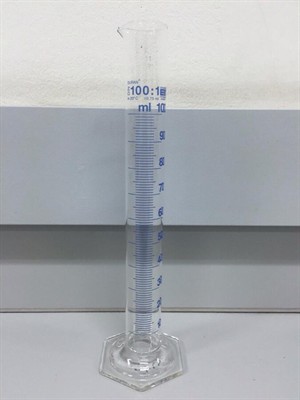
Measuring cylinder 100 mL
Observation of a measuring cylinder:
i. Maximum volume of the cylinder: The cylinder is marked up to \(100\ mL\), hence its maximum capacity is \(100\ mL\).
ii. The volume difference between the two bigger marks: The two successive big marks have a volume difference of \(10\ mL\).
Example: From \(10\ mL\) to \(20\ mL\)
iii. Smaller divisions: The number of smaller divisions between the two successive bigger marks is \(10\)
iv. Least count: One small division can read the volume of \(1 mL\)
The smallest volume that can be represented by the \(100\ mL\) measuring cylinder is \(1 mL\).
Therefore, the least count is \(1\ small\ division = 1\ mL\)
Similarly, the least count varies depending on the capacity of the measuring cylinder.
- Measuring cylinders such as \(10 mL\) or \(25 mL\) can measure as small as \(0.1 mL\).
- The least count of a \(250 mL\) capacity cylinder is \(2 mL\).
- The least count of a \(500 mL\) capacity cylinder is \(5 mL\).
Thus, smaller-capacity measuring cylinders give more accurate values.
Reference:
https://resources.cdn.yaclass.in/7e0dd082-ad62-4ace-a0b9-d847d868038f/3w834.png
https://upload.wikimedia.org/wikipedia/commons/thumb/7/7d/A_graduated_cylinder.jpg/675px-A_graduated_cylinder.jpg?20150625065533
https://commons.wikimedia.org/wiki/File:Different_types_of_graduated_cylinder-_10ml,_25ml,_50ml_and_100_ml_graduated_cylinder.jpg