

Everything around us, from the air we breathe and the water we drink to the food we eat, is made of matter. Matter undergoes various physical and chemical changes in our daily lives. Scientists carefully observed these changes and performed experiments to understand how matter behaves during such transformations.
i. Physical change and mass conservation:
- A physical reaction does not produce any new substances.
- Although usually reversible in many aspects, it may be a slow process or even irreversible, like breaking a glass object or cutting paper into pieces.
- The changes generally occur only in the physical properties, such as size, shape, colour and state. The changes are involved in the form, not in the substance identity.
Activity:
Take \(5\ g\) of salt and dissolve in \(100\ g\) of water. Stir untill the salt dissolves completely. The salt is still present in the solution even though it is not visible.
If the total mass is measured:
Mass before mixing = \(5\ g + 100\ g = 105\ g\)
Mass after mixing = \(105\ g\)
Conclusion:
Even though the appearance changes, no new substance is formed. Also, the total mass remains the same. This shows that the mass is conserved in physical changes.
ii. Chemical change and mass conservation:
- A chemical reaction forms a new substance and it does not destroy matter.
- Chemical changes are irreversible.
- There are several indicators of a chemical change, including a change in chemical properties, a colour change, the evolution of gas, and the absorption or release of heat or light during the reaction.
Activity:
A chemical reaction is carried out between vinegar and baking soda. When vinegar is added to baking soda, a chemical reaction takes place immediately and following changes are observed,
- Rapid bubbling or effervescence
- Formation of a gas (carbon dioxide)
- Formation of new substances
\(\text{Baking soda} + \text{Vinegar} \to \text{Salt} + \text{Water} + \text{Carbon dioxide}\)
\(NaHCO_3 + CH_3COOH \to CH_3COONa + H_2O + CO_2\)
Case 1: Open system:
The reaction is carried out in an open container like conical flask.
Observation:
- Before reaction: total mass is measured.
- After reaction: mass appears to decrease.
Conclusion:
The decrease in mass is not due to loss of matter. It is because,
- The reaction produces carbon dioxide gas. This gas is released into the air.
- Since it escapes, it is not included in the final measurement.
Case 2: Closed system:
The same reaction is repeted in a closed setup, the flask is sealed with a balloon is attached to collect the gas.
Observation:
Mass before reaction = Mass after reaction
Conclusion:
The experiment demonstrates that,
- Total mass remains constant in a closed system
- Mass can neither be created nor destroyed in a chemical reaction.
Law of conservation of mass:
Scientist observed the chemical experiments and stated that the mass of the reactants at the beginning of a reaction would be equal to the mass of the products at the end of the reaction. Antoine Lavoisier is known as the Father of Modern Chemistry. He proposed the Law of Conservation of Mass. This law applies to every chemical reaction.
“The mass in an isolated system can neither be created nor destroyed but can be transformed from one form to another”
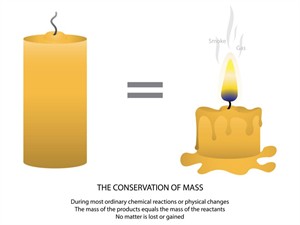
Law of conservation of mass
Example: In a group activity, students place \(4.0\ g\) of calcium carbonate with \(2.92\ g\) of hydrochloric acid in a closed container. After the reaction is over, they measured \(1.76\ g\) of carbon dioxide, \(0.72\ g\) of water, and \(4.44\ g\) of calcium chloride. Verify whether the Law of Conservation of Mass is obeyed or not.
Solution:
Mass of calcium carbonate = \(4.0\ g\)
Mass of hydrochloric acid = \(2.92\ g\)
Total mass of reactants: \(4.0\ g + 2.92\ g = 6.92\ g\)
Mass of hydrochloric acid = \(2.92\ g\)
Total mass of reactants: \(4.0\ g + 2.92\ g = 6.92\ g\)
Mass of carbon dioxide = \(1.76\ g\)
Mass of water = \(0.72\ g\)
Mass of calcium chloride = \(4.44\ g\)
Total mass of products: \(1.76\ g + 0.72\ g + 4.44\ g = 6.92\ g\)
Law of constant (definite) proportion:
The elements are always present in definite proportions by mass in a chemical substance.
The great scientist Lavoisier, along with other scientists, observed that compounds are composed of two or more elements; and each such compound had the same elements in the same proportions, irrespective of where the compound came from or who prepared it.
In water (\(H_2O\)), the ratio of the mass of hydrogen to oxygen is always \(1:8\), whether it is tap water, rainwater, or distilled water.
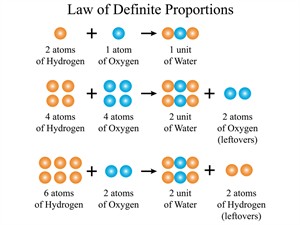
Law of constant proportion
Example: Sodium chloride (\(NaCl\)) contains sodium and chlorine in the mass ratio of \(23:35.5\). If \(46\ g\) of sodium reacts completely, how much chlorine is needed to form \(NaCl\)?
Solution:
Mass of chlorine required = \((35.5 ÷ 23) × 46\) = \(71\ g\)
This is known as the Law of Constant Proportions,or the Law of Definite Proportions, or sometimes as Proust’s Law.
Dalton’s Atomic Theory:
This theory attempts to logically explain why substances combine in fixed proportions and why there is no loss or gain of mass during a chemical reaction.
Dalton later explained these by proposing that during a chemical reaction, atoms are indivisible and merely rearrange, rather than being created or destroyed.
Postulates of Dalton’s Atomic Theory:
- All matter is made up of very tiny particles called atoms, which participate in chemical reactions.
- Atoms are indivisible particles, which cannot be created or destroyed in a chemical reaction.
- Atoms of a given element are identical in mass and chemical properties.
- Atoms of different elements have different masses and chemical properties.
- Atoms combine in the ratio of simple whole numbers to form compounds.
- The relative number and kinds of atoms are constant in a given compound.
Example:
Hydrogen and oxygen atoms combine to form water, but the atoms themselves are not destroyed or changed into something else.
Similarly, when magnesium burns in air, a white powder of magnesium oxide forms. This shows that the atoms of magnesium have combined with those of oxygen to form magnesium oxide.
Similarly, when magnesium burns in air, a white powder of magnesium oxide forms. This shows that the atoms of magnesium have combined with those of oxygen to form magnesium oxide.
| Topic | Key Learning |
| Antoine Lavoisier (1743–1794) | Known as the Father of Modern Chemistry. Through carefully designed experiments, he established the Law of Conservation of Mass, which states that mass is neither created nor destroyed during a chemical reaction. He emphasized accurate measurement in scientific investigations. |
| Joseph Louis Proust (1754–1826) | Proposed the Law of Constant Proportions, stating that a pure compound always contains the same elements combined in a fixed proportion by mass, irrespective of its source or method of preparation. |
| Cinnabar (Mercury Ore) | Cinnabar is a naturally occurring mineral containing mercury and sulfur in mass percentage of around \(86.22\)% and \(13.78\)%, respectively. Regardless of where it is found, its composition remains constant, illustrating the Law of Constant Proportions. This example shows that pure compounds always have a definite composition. |
| John Dalton (1766–1844) | Proposed the Atomic Theory to explain the laws of chemical combination. Dalton stated that all matter is made up of tiny particles called atoms, atoms of the same element are identical, atoms of different elements differ, and atoms combine in simple whole-number ratios to form compounds. His theory successfully explained the Law of Conservation of Mass and the Law of Constant Proportions. |