

Formation of Compounds & Bonding:
Atoms of an element can combine to form a molecule of that element. Atoms of different elements combine to form a molecule of a compound.
This generally takes place in two ways. These are:
- Sharing of electrons — Share a few or all of their valence electrons with another atom.
- Transfer of electrons — Transfer one or more of the valence electrons to another atom, or accept one or more electrons from some other atom.
When atoms combine, the total energy of the system becomes lower than the sum of the energies of the individual atoms, making the resulting arrangement more stable. The force that holds atoms together is called a chemical bond.
Bonding by sharing of electrons — Covalent Bond:
A. Molecules of elements:
Formation of a hydrogen molecule:
- The electronic configuration of hydrogen (atomic number \(1\)) is \(1\). It has only one electron in the K-shell. Since, a K-shell can have a total of two electrons, it needs one more electron to become stable. Thus, a hydrogen atom shares one electron with another hydrogen atom to form a hydrogen molecule \((H_{2})\). The shared pair of electrons attracts both the nuclei and makes the molecule stable.
- This type of interaction between atoms through a shared pair of electrons is called a covalent bond. If two atoms are joined by sharing one electron each, they are said to be joined by a single bond.
- In case of an oxygen molecule, the two atoms are joined by two pairs of shared electrons, and are held together by a double bond. It can be depicted by drawing two lines between two oxygen atoms as \(O=O\).
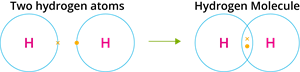
Formation of hydrogen molecule
B. Molecules of compounds:
Formation of hydrogen chloride molecule:
- The electronic configurations of hydrogen atom is \(1\) and chlorine atom is \(2,8,7\) (atomic number of hydrogen is \(1\) and chlorine is \(17\)).
- The atoms of both hydrogen and chlorine need one electron each to attain stable electronic configurations. Hence, both the atoms share one electron each to form a molecule of hydrogen chloride.
- Since the hydrogen and chlorine atoms in a hydrogen chloride \((HCl)\) molecule bond by sharing electrons, it is a covalent compound. Also, since hydrogen and chlorine atoms share one pair of electrons, they are bonded by a single bond and it can be depicted as \(H - Cl\).
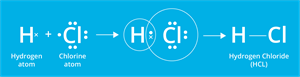
Formation of hydrogen chloride molecule
C. Naming covalent compounds:
Covalent compounds are named by indicating the number of atoms of each element in the compound. To name these compounds, a prefix system is used to indicate the number of atoms of each element in the molecule. The first element retains its regular name, while the second element ends in -ide.
Prefixes, such as mono- \((1)\), di- \((2)\), tri- \((3)\), tetra- \((4)\), penta- \((5)\), hexa- \((6)\), etc., indicate the number of atoms. However, mono- is usually omitted for the first element but is used for the second element. If a prefix ends with ‘o’ or ‘a’ and the element starts with a vowel, drop the last vowel (for example, monoxide, pentoxide).
Prefixes, such as mono- \((1)\), di- \((2)\), tri- \((3)\), tetra- \((4)\), penta- \((5)\), hexa- \((6)\), etc., indicate the number of atoms. However, mono- is usually omitted for the first element but is used for the second element. If a prefix ends with ‘o’ or ‘a’ and the element starts with a vowel, drop the last vowel (for example, monoxide, pentoxide).
Example:
\(CO\) is named as carbon monoxide (not monooxide).
\(CO_{2}\) is named as carbon dioxide (not monocarbon dioxide).
\(CO_{2}\) is named as carbon dioxide (not monocarbon dioxide).
Important!
A few binary compounds are known only by their common names. For example, \(H_{2}O\), which would usually be named hydrogen monoxide, is commonly known as water. Similarly, \(NH_{3}\), which is actually nitrogen trihydride, is known as ammonia.
Bonding by electron transfer — Ionic bond:
If the valence shell of an atom has less than four electrons, it would generally donate its valence electrons to achieve a stable electronic configuration. Atoms with more than \(4\) valence electrons usually gain or share electrons to complete an octet.
Bonding in \(NaCl\):
- The atomic number of sodium is \(11\). Its valence shell contains only one electron, which can attain a stable electronic configuration after losing this valence electron.
- When sodium atom loses its valence electron, it becomes a positively charged species, called a sodium cation, represented as \(Na^{+}\). It is so because it would have \(11\) protons and \(10\) electrons.
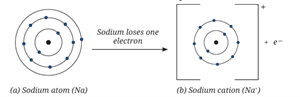
Formation of a sodium cation
- On the other hand, the electronic configuration of a chlorine atom shows that it has seven valence electrons. It can attain a stable electronic configuration by gaining one electron from another atom. After gaining one extra electron, it acquires a negative charge and is called a chloride anion, represented as \(Cl^{–}\).
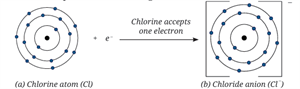
Formation of a chloride anion
- Cations and anions are collectively called ions. Once the sodium and chloride ions are formed, they are held together by the electrostatic force of attraction due to their opposite charges. The electrostatic force of attraction between oppositely charged ions that holds them together is called an ionic bond.
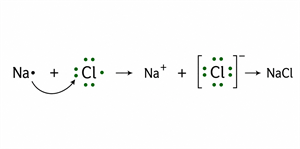
Formation of sodium chloride
- Some elements like sulfur have six electrons in their outer shell and need to gain two electrons to complete their octet. When a sulfur atom gains two electrons, it acquires two units of negative charge and is represented as \(S^{2–}\).
A. Naming ionic compounds:
In naming ionic compounds, the name of the cation is written first, followed by the name of the anion. Names of simple anions end with -ide. Generally, metals form cations and non-metals form anions. Ionic compounds are typically formed when metals combine with non-metals.
Example:
Sodium chloride, Calcium oxide, Magnesium sulfide, etc.
Some ions are formed by the combination of atoms of two or more elements, and are called polyatomic ions.
Example:
Hydroxide \(OH^{-}\), Sulfate \(SO_{4}^{2-}\) etc.
Writing Chemical Formulae:
I. Writing chemical formulae of covalent compounds:
Follow these steps to write the chemical formula of a covalent compound:
(i) Write the symbols of the constituent elements of the compound.
(ii) Write the valencies of these elements.
(iii) Crossover the valencies of the combining atoms and write them as subscripts after the symbols of elements, as shown below.
(i) Write the symbols of the constituent elements of the compound.
(ii) Write the valencies of these elements.
(iii) Crossover the valencies of the combining atoms and write them as subscripts after the symbols of elements, as shown below.
|
Formula of Water:
We know the symbol for hydrogen \(H\) and oxygen \(O\).
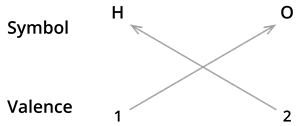 Formula: \(H_{2}O\)
|
Formula of Hydrogen sulphide :
We know the symbol for hydrogen \(H\) and sulphide \(S\).
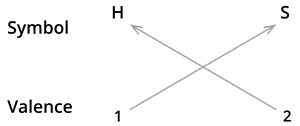 Formula: \(H_{2}S\)
|
Formula of Carbon tetrachloride:
We know the symbol for carbon \(C\) and chlorine \(Cl\).
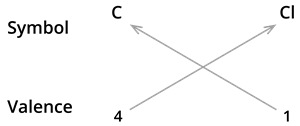 Formula: \(CCl_{4}\)
|
II. Writing chemical formulae of ionic compounds
Follow the steps given below to write the chemical formula of an ionic compound:
(i) Write the symbol of the cation first, followed by the symbol of the anion.
(i) Write the symbol of the cation first, followed by the symbol of the anion.
(ii) Write the charges under the symbols rather than as superscripts.
(iii) Crossover the charges (only the numbers) as shown below to obtain the formula.
(iv) The chemical formula gives the simplest ratio of the elements in a compound. Therefore, after criss-crossing, the subscripts are divided by a common factor, if any.
(iii) Crossover the charges (only the numbers) as shown below to obtain the formula.
(iv) The chemical formula gives the simplest ratio of the elements in a compound. Therefore, after criss-crossing, the subscripts are divided by a common factor, if any.
|
Formula of Magnesium chloride:
We know the symbol for magnesium \(Mg\) and chlorine \(Cl\).
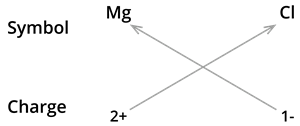 Formula: \(MgCl_{2}\)
|
Formula of Aluminium oxide:
We know the symbol for aluminium \(Al\) and oxygen \(O\).
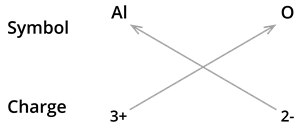 Formula: \(Al_{2}O_{3}\)
|
Formula of Calcium hydroxide:
We know the symbol for calcium \(Ca\) and hydroxyl groups \(OH\).
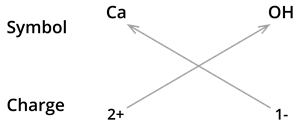 Formula: \(Ca(OH)_{2}\)
|