

Properties of Covalent compound:
- Most covalent compounds, such as camphor and naphthalene are insoluble in water but dissolve in kerosene and petrol.
- Some covalent compounds, such as sugar, are soluble in water but do not provide ions in solution; therefore, they do not conduct electricity. Other covalent compounds, such as camphor and naphthalene, also do not conduct electricity.
- Covalent compounds usually have low melting and boiling points.
Properties of the Ionic Compounds:
- Ionic compounds like sodium chloride and copper sulfate are generally soluble in water but insoluble in solvents, such as kerosene and petrol.
- Ionic compounds do not conduct electricity in the solid state because their ions are held in fixed positions by strong forces. To conduct electricity, ions must be free to move, which occurs only when the ionic compounds, such as sodium chloride and copper sulfate, are dissolved in water.
- Ionic compounds generally have high melting and boiling points due to strong inter-ionic attractions.
Molecular Mass :
In atomic mass, we get the mass of the atom alone, but in the molecular mass, we get the mass of the total molecule.
Molecular mass of a substance is the sum of the atomic masses of all the atoms in a molecule of a substance. It is, therefore, the relative mass of a molecule expressed in atomic mass units \((u)\).
For instance, the molecular mass of \(H_{2}O\) is two times the mass of one \(H\) atom plus the mass of one \(O\) atom.
Molecular mass of \(H_{2}O\) = \(2\) × Mass of \(H\) atom + Mass of one \(O\) atom = \(2 ×1 + 16 = 18 u\).
Formula unit mass :
In ionic compounds, the collection of the simplest whole number ratio of ions is termed as a formula unit. The mass of a formula unit is called the formula unit mass.
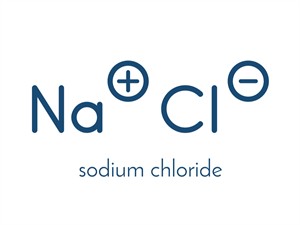
Ionic form of \(NaCl\)
Example:
The formula unit mass of \(NaCl\) = \(1×23 + 1×35.5 = 58.5\ u \).