

Molecular Mass :
In atomic mass, we get the mass of the atom alone, but in the molecular mass, we get the mass of the total molecule.
Molecular mass of a substance is the sum of the atomic masses of all the atoms in a molecule of a substance. It is, therefore, the relative mass of a molecule expressed in atomic mass units \((u)\).
For instance, the molecular mass of \(H_{2}O\) is two times the mass of one \(H\) atom plus the mass of one \(O\) atom.
Molecular mass of \(H_{2}O\) = \(2\) × Mass of \(H\) atom + Mass of one \(O\) atom = \(2 ×1 + 16 = 18 u\).
Formula unit mass :
In ionic compounds, the collection of the simplest whole number ratio of ions is termed as a formula unit. The mass of a formula unit is called the formula unit mass.
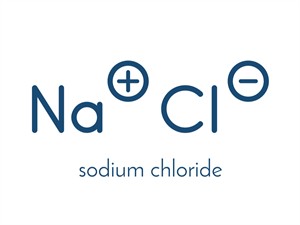
Ionic form of \(NaCl\)
Example:
The formula unit mass of \(NaCl\) = \(1×23 + 1×35.5 = 58.5 u \).
Writing Chemical Formulae:
I. Writing chemical formulae of covalent compounds:
Follow these steps to write the chemical formula of a covalent compound:
(i) Write the symbols of the constituent elements of the compound.
(ii) Write the valencies of these elements.
(iii) Crossover the valencies of the combining atoms and write them as subscripts after the symbols of elements, as shown below.
(i) Write the symbols of the constituent elements of the compound.
(ii) Write the valencies of these elements.
(iii) Crossover the valencies of the combining atoms and write them as subscripts after the symbols of elements, as shown below.
|
Formula of Water:
We know the symbol for hydrogen \(H\) and oxygen \(O\).
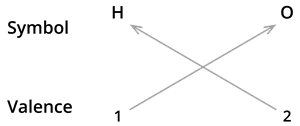 Formula: \(H_{2}O\)
|
Formula of Hydrogen sulphide :
We know the symbol for hydrogen \(H\) and sulphide \(S\).
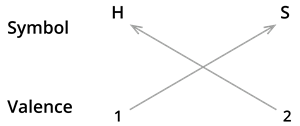 Formula: \(H_{2}S\)
|
Formula of Carbon tetrachloride:
We know the symbol for carbon \(C\) and chlorine \(Cl\).
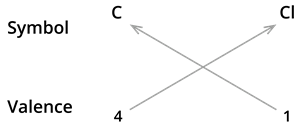 Formula: \(CCl_{4}\)
|
II. Writing chemical formulae of ionic compounds:
Follow the steps given below to write the chemical formula of an ionic compound:
(i) Write the symbol of the cation first, followed by the symbol of the anion.
(i) Write the symbol of the cation first, followed by the symbol of the anion.
(ii) Write the charges under the symbols rather than as superscripts.
(iii) Crossover the charges (only the numbers) as shown below to obtain the formula.
(iv) The chemical formula gives the simplest ratio of the elements in a compound. Therefore, after criss-crossing, the subscripts are divided by a common factor, if any.
(iii) Crossover the charges (only the numbers) as shown below to obtain the formula.
(iv) The chemical formula gives the simplest ratio of the elements in a compound. Therefore, after criss-crossing, the subscripts are divided by a common factor, if any.
|
Formula of Magnesium chloride:
We know the symbol for magnesium \(Mg\) and chlorine \(Cl\).
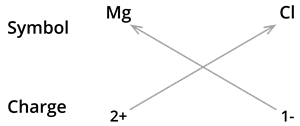 Formula: \(MgCl_{2}\)
|
Formula of Aluminium oxide:
We know the symbol for aluminium \(Al\) and oxygen \(O\).
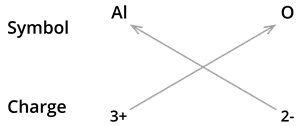 Formula: \(Al_{2}O_{3}\)
|
Formula of Calcium hydroxide:
We know the symbol for calcium \(Ca\) and hydroxyl groups \(OH\).
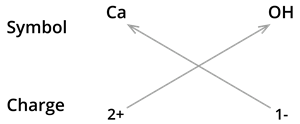 Formula: \(Ca(OH)_{2}\)
|