

Formation of Compounds & Bonding:
Atoms of an element can combine to form a molecule of that element. Atoms of different elements combine to form a molecule of a compound.
This generally takes place in two ways. These are:
- Sharing of electrons — Share a few or all of their valence electrons with another atom.
- Transfer of electrons — Transfer one or more of the valence electrons to another atom, or accept one or more electrons from some other atom.
When atoms combine, the total energy of the system becomes lower than the sum of the energies of the individual atoms, making the resulting arrangement more stable. The force that holds atoms together is called a chemical bond.
Bonding by electron transfer — Ionic bond:
If the valence shell of an atom has less than four electrons, it would generally donate its valence electrons to achieve a stable electronic configuration. Atoms with more than \(4\) valence electrons usually gain or share electrons to complete an octet.
Bonding in \(NaCl\):
- The atomic number of sodium is \(11\). Its valence shell contains only one electron, which can attain a stable electronic configuration after losing this valence electron.
- When sodium atom loses its valence electron, it becomes a positively charged species, called a sodium cation, represented as \(Na^{+}\). It is so because it would have \(11\) protons and \(10\) electrons.
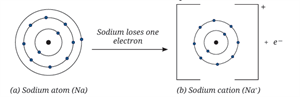
Formation of a sodium cation
- On the other hand, the electronic configuration of a chlorine atom shows that it has seven valence electrons. It can attain a stable electronic configuration by gaining one electron from another atom. After gaining one extra electron, it acquires a negative charge and is called a chloride anion, represented as \(Cl^{–}\).
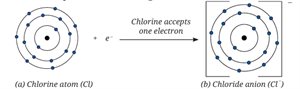
Formation of a chloride anion
- Cations and anions are collectively called ions. Once the sodium and chloride ions are formed, they are held together by the electrostatic force of attraction due to their opposite charges. The electrostatic force of attraction between oppositely charged ions that holds them together is called an ionic bond.
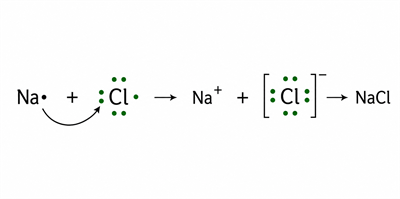
Formation of sodium chloride
- Some elements like sulfur have six electrons in their outer shell and need to gain two electrons to complete their octet. When a sulfur atom gains two electrons, it acquires two units of negative charge and is represented as \(S^{2–}\).
A. Naming ionic compounds:
In naming ionic compounds, the name of the cation is written first, followed by the name of the anion. Names of simple anions end with -ide. Generally, metals form cations and non-metals form anions. Ionic compounds are typically formed when metals combine with non-metals.
Example:
Sodium chloride, Calcium oxide, Magnesium sulfide, etc.
Some ions are formed by the combination of atoms of two or more elements, and are called polyatomic ions.
Example:
Hydroxide \(OH^{-}\), Sulfate \(SO_{4}^{2-}\) etc.
Properties of the Ionic Compounds:
- Ionic compounds like sodium chloride and copper sulfate are generally soluble in water but insoluble in solvents, such as kerosene and petrol.
- Ionic compounds do not conduct electricity in the solid state because their ions are held in fixed positions by strong forces. To conduct electricity, ions must be free to move, which occurs only when the ionic compounds, such as sodium chloride and copper sulfate, are dissolved in water.
- Ionic compounds generally have high melting and boiling points due to strong inter-ionic attractions.