

The Sun is the main source of energy for Earth, but its heat is not distributed equally across the planet. Different regions receive different amounts of solar energy, causing variations in temperature and air pressure. These differences set the air and water in motion, producing winds and ocean currents. From gentle sea breezes near the coast to large-scale movements of air and ocean water, uneven heating plays a major role in shaping Earth’s climate and weather.
Local winds:
Uneven heating of the Earth’s surface produces local winds such as valley breezes and mountain breezes. In mountainous regions, mountain slopes and valley floors heat and cool at different rates.
During the day, mountain slopes facing the Sun heat up quickly. The air above the slopes becomes warm and rises, creating a low-pressure region. Cooler air from the valley moves up the slopes, producing a valley breeze.
After sunset, the mountain slopes cool faster than the valley floor. The air over the slopes becomes cooler and denser and flows down into the valley. This is called a mountain breeze.
These daily changes in wind direction are common in hilly and Himalayan regions. Local winds influence temperature, moisture, agriculture, and daily life in these areas.
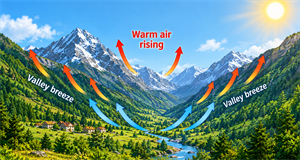 Valley breeze
|
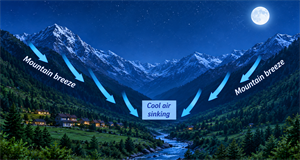 Mountain breeze
|
Planetary Winds:
Uneven heating between the equator and poles creates global belts of high and low pressure, producing planetary winds that travel over long distances.
Near the equator, intense heating makes warm air rise, creating an equatorial low-pressure belt. The rising air moves towards the poles, cools, and sinks around \(30° N\) and \(30° S\), forming sub-tropical high-pressure belts. Some air returns towards the equator, while some moves towards higher latitudes.
Around \(60° N\) and \(60° S\), warm and cold air meet, causing air to rise and forming sub-polar low-pressure belts. At the poles, cold and dense air sinks, creating polar high-pressure belts.
The rotation of the Earth deflects these winds from their straight paths. They are deflected towards the right in the Northern Hemisphere and towards the left in the Southern Hemisphere.
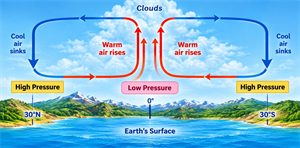 Wind circulation between equatorial low pressure belt
and sub-tropical high pressure belt
|
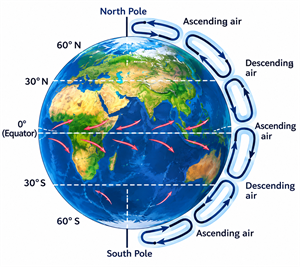 The distribution of pressure belts and
planetary winds |
Ocean Currents:
Ocean currents are the continuous movement of large masses of ocean water, driven mainly by planetary winds and differences in pressure. Their movement is also influenced by temperature, salinity, Earth’s rotation, and continents.
Warm equatorial water flows towards the poles near the surface, while cold, dense water moves back towards the equator through deeper layers. Higher-salinity water is denser and sinks, while less-salty water remains near the surface.
Earth’s rotation causes ocean currents to form large circular patterns called gyres. These move clockwise in the Northern Hemisphere and counterclockwise in the Southern Hemisphere, while continents change their paths.
Ocean currents help regulate Earth’s climate, transport heat and nutrients, and support marine life. The North Atlantic Drift carries warm water towards Europe and helps keep some ports ice-free during winter.
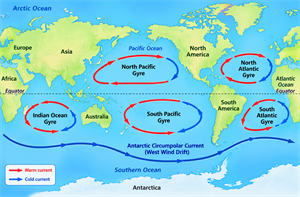 Global surface ocean currents showing circulation like gyres
|
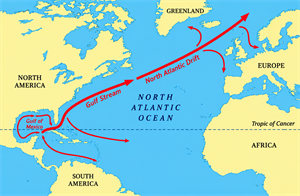 Gulf Stream brings warm water
from the equator |