

The atmosphere is the layer of air surrounding the Earth, held in place by the Earth's gravity. It is composed mainly of nitrogen \((78%)\) and oxygen \((21%)\), along with small amounts of argon, carbon dioxide, water vapour, and other gases.
The atmosphere has a layered structure, and each layer plays a specific role in regulating weather, climate, and life on Earth.
- The troposphere is the lowest layer, extending to an average height of about \(12\ km\). Almost all weather phenomena, such as clouds, rain, winds, and storms, occur in this layer. It is heated from the Earth's surface, and the temperature decreases with height at an average rate of about \(6.5°C\) per kilometre. The troposphere is thickest above the equator and thinnest above the polar regions.
- Above the troposphere lies the stratosphere \((12–50\ km)\), which contains the ozone layer. Ozone absorbs harmful ultraviolet (UV) radiation from the Sun, causing the temperature to increase with height. This temperature increase reduces vertical air movement, keeping most weather activities confined to the troposphere.
- The mesosphere, thermosphere, and exosphere lie above the stratosphere. These upper layers play only a minor role in regulating the Earth's surface climate.
- At approximately \(100\ km\) above the Earth, outer space begins.
Overall, the atmosphere regulates the flow of energy, controls weather and climate, protects life from harmful radiation, and makes Earth a habitable planet.
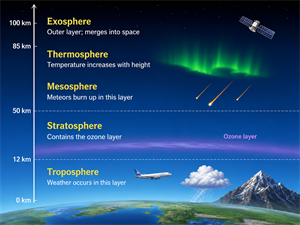
Layers of the Earth’s atmosphere
The atmosphere protects life on Earth by absorbing harmful UV radiation through the ozone layer and by trapping heat through the greenhouse effect. Greenhouse gases such as \(CO_{2}\), \(CH_{4}\), and water vapour retain heat, keeping Earth warm enough for life. However, excess \(CO_{2}\) from human activities enhances the greenhouse effect, leading to global warming.
The atmosphere also regulates weather, climate, and energy balance, making Earth a unique and habitable planet. The ozone layer acts as a protective shield against harmful UV rays. In the late 20th century, CFCs caused severe ozone depletion over Antarctica, creating the ozone hole. The Montreal Protocol reduced CFC use, and the ozone layer is now gradually recovering, demonstrating the success of international cooperation in addressing environmental problems.
K. R. Ramanathan, a pioneering Indian atmospheric scientist, climbed to \(18,000\) feet in the Himalayas in \(1934\) to measure ozone levels. He found that ozone concentrations were lower than expected, helping scientists understand how UV absorption changes with altitude and pollution levels. His research contributed significantly to atmospheric science, and he later played an important role in developing early monsoon forecasting in India.