

Biogeochemical cycles:
Biogeochemical cycles are the continuous movement of matter and energy between the living (biotic) and non-living (abiotic) parts of the Earth. Living organisms constantly interact with air, water, soil, and rocks, helping essential nutrients such as carbon, nitrogen, and oxygen to be recycled and reused. These cycles ensure that nutrients remain available to support life. Different ecosystems are interconnected, and this connection helps maintain environmental balance and recover from disturbances.
The major biogeochemical cycles include the water, carbon, nitrogen, and oxygen cycles, which link Earth's spheres and are influenced by human activities.
Water cycle:
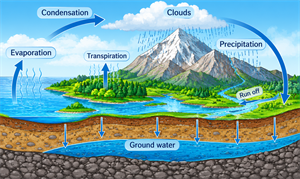
The water cycle is the continuous movement of water between the atmosphere, land, oceans, and living organisms. Water evaporates from rivers, lakes, and oceans, condenses to form clouds, and returns to the Earth as precipitation in the form of rain, hail, or snow. Some water infiltrates into the ground to become groundwater, while the rest flows back to rivers and oceans. Water also dissolves minerals from soil and rocks and transports nutrients that support both terrestrial and marine life.
Climate change is affecting the water cycle by increasing the amount of moisture in the atmosphere, leading to heavier rainfall in some regions and droughts in others. Melting glaciers add more water to rivers and contribute to rising sea levels, threatening coastal cities. Intense rainfall increases runoff and soil erosion while reducing groundwater recharge. The water cycle connects the cryosphere, hydrosphere, atmosphere, geosphere, and biosphere, and changes in one sphere can affect all the others.
Carbon cycle:
- Carbon is essential for life because it is present in proteins, carbohydrates, fats, and DNA.
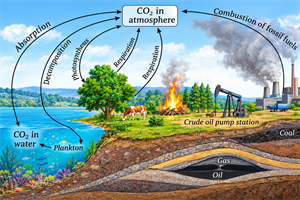
- Carbon continuously circulates among the atmosphere, biosphere, geosphere, and hydrosphere.
- The fast carbon cycle operates over days to years. Plants absorb atmospheric \(CO₂\) during photosynthesis and convert it into glucose. Respiration releases \(CO₂\) back into the atmosphere, while decomposition returns carbon after organisms die.
- The slow carbon cycle operates over millions of years. Buried remains of plants and animals are converted into fossil fuels such as coal, oil, and gas.
- Burning fossil fuels for heating, cooking, transportation, and industrial purposes releases stored carbon rapidly back into the atmosphere as \(CO₂\).
- The atmosphere and oceans continuously exchange \(CO₂\). Ocean water absorbs \(CO₂\) to form carbonate and bicarbonate ions, which are used by phytoplankton and some marine organisms.
- Some marine organisms use carbon to form shells. After they die, their remains sink to the ocean floor, where carbon can be stored for long periods.
- Human activities, especially burning fossil fuels and deforestation, have increased atmospheric \(CO₂\) significantly by about \(35%\) since \(1960\ \)as shown \((315\ ppm\ to\ 420\ ppm\); ppm denotes parts per million), an unprecedented rise in the history of human civilisation.
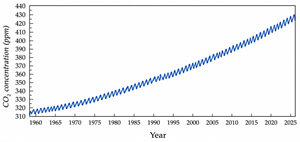
The Keeling curve
- Excess \(CO₂\) strengthens the greenhouse effect, contributing to global warming, melting glaciers and Arctic sea ice, rising sea levels, and more extreme weather.
- In India, changing climate conditions may result in more intense monsoons and changing rainfall patterns, creating challenges for agriculture.
- Increasing renewable energy sources can help reduce the amount of carbon released into the atmosphere.
Nitrogen cycle:
- Nitrogen is essential for making proteins and nucleic acids in living organisms.
- The atmosphere is the largest reservoir of nitrogen, but atmospheric nitrogen \(N₂\) gas is relatively non-reactive and cannot be directly used by plants and animals.
- Nitrogen must first be converted into soluble compounds that living organisms can absorb.
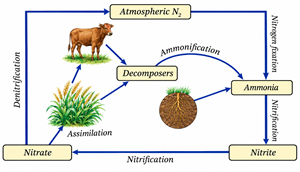
- The movement of nitrogen between the air, soil, water, and living organisms is called the nitrogen cycle.
- The nitrogen cycle involves five major steps: nitrogen fixation, assimilation, ammonification, nitrification, and denitrification.
Five major steps are:
- Nitrogen fixation: Nitrogen-fixing bacteria such as Rhizobium in legume root nodules and Azotobacter in soil convert atmospheric \(N₂\) into ammonia \((NH₃)\). Lightning also contributes to nitrogen fixation.
- Nitrification: Nitrosomonas converts ammonia into nitrite \((\)\()\), while Nitrobacter converts nitrite into nitrate \((\)\()\).
- Assimilation: Plants absorb nitrogen compounds from the soil. Animals obtain nitrogen by eating plants or other animals.
- Ammonification: When plants and animals die or produce waste, decomposers such as bacteria and fungi break down organic matter and return nitrogen compounds such as ammonia to the soil.
- Denitrification: Bacteria such as Pseudomonas convert some nitrates back into nitrogen gas, returning nitrogen to the atmosphere.
Oxygen cycle:
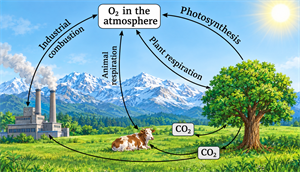
- Oxygen is one of the most abundant elements on Earth, with about \(21%\) of the atmosphere consisting of free oxygen gas \((O₂)\).
- It is an essential component of biological molecules such as carbohydrates, proteins, nucleic acids, and fats.
- Oxygen also occurs in combined forms, such as metal oxides and minerals in the Earth's crust and carbon dioxide \((CO₂)\) in the air.
- Plants and animals use oxygen during respiration, releasing \(CO₂\).
- Combustion of fuels also consumes oxygen and releases \(CO₂\).
- Plants restore atmospheric oxygen through photosynthesis, using sunlight, water, and \(CO₂\) to form glucose and release \(O₂\).
- The oxygen cycle maintains a balance between oxygen consumption through respiration and combustion and oxygen production through photosynthesis.
- This continuous circulation of oxygen between the atmosphere, land, oceans, and living organisms helps sustain life across Earth's spheres.
Human impact on Earth’s processes:
Human activities are significantly disrupting biogeochemical cycles and natural systems across Earth’s spheres.
- Rising CO₂: Burning fossil fuels increases atmospheric \(CO₂\), contributing to extreme weather, biodiversity loss, and stronger greenhouse warming. Excess \(CO₂\) is absorbed by oceans, increasing ocean acidity, which can threaten plankton and coral reefs.
- Oceans as carbon sinks: Warmer ocean water has a reduced capacity to absorb \(CO₂\), weakening the ocean’s role as a carbon sink. Fossil-fuel burning and deforestation also place pressure on natural carbon sinks such as forests and oceans.
- Fossil fuels and energy: Fossil fuels continue to provide a significant part of India’s electricity and contribute to harmful emissions, while the rapid expansion of solar energy provides hope for reducing this impact.
- Fertilisers and eutrophication: Excessive fertiliser use adds nitrates to rivers and lakes, causing algal blooms. These blooms deplete oxygen in water, which can kill fish. This process is called eutrophication and can threaten water bodies and coastal fisheries.
- Deforestation: Clearing forests reduces photosynthesis and transpiration, which can decrease local rainfall. It also changes surface albedo, increases soil erosion because tree roots no longer hold soil together, and destroys habitats, leading to biodiversity loss.
- Vehicular pollution: Vehicle emissions react with sunlight to produce ground-level smog and ground-level ozone, which are harmful to health. This is different from stratospheric ozone, which protects life by blocking harmful UV radiation.
- Global cooperation: Human impacts affect all Earth’s spheres, but local actions and international cooperation can help restore natural systems. The Montreal Protocol has contributed to the recovery of the ozone layer, while the Kyoto Protocol and Paris Agreement have been less successful in achieving intended \(CO₂\) emission reductions.
- Solutions: Conserving energy and resources, shifting to renewable energy such as solar and wind, planting trees, saving water, sustainable farming, reducing waste, reusing materials, and recycling can help restore environmental balance.
- India’s efforts: India has expanded solar and renewable energy, planted billions of trees, and promoted sustainable farming practices.