

Life on Earth depends on a continuous flow of energy and matter. The Sun is the main source of energy, while heat from Earth’s interior and chemical reactions in air, water and rocks also contribute to these processes. In earlier classes, processes such as winds, the water cycle, nutrient cycling, seasons and human impacts on the environment were studied separately. This chapter brings these ideas together by viewing Earth as one interconnected system.
The Earth functions as a single system made up of five interacting spheres:
- Geosphere: Solid rocks, soil, landforms and Earth’s interior.
- Hydrosphere: Liquid water in oceans, rivers, lakes and groundwater.
- Cryosphere: Frozen water such as ice, snow, glaciers and polar ice caps.
- Atmosphere: The layer of air surrounding Earth.
- Biosphere: All living organisms and their habitats.
These spheres are interconnected. Energy and matter move between them through processes such as solar heating, movement of air and water, and nutrient cycling. Therefore, a change in one sphere can affect the others.
Aim:
To understand how the five spheres of Earth are interconnected and how a change in one sphere can affect the others.
Procedure:
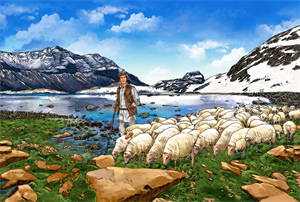
Observe the features of Earth shown in figure and identify examples of the geosphere, hydrosphere, cryosphere, atmosphere and biosphere.
Questions for discussion:
- How does snow from the cryosphere eventually become part of a lake in the hydrosphere?
- If snowfall decreases during winter for several years, what changes might occur in the lake level and the grass available for sheep?
- How are the five spheres of Earth interconnected?
- How can a disturbance in one sphere lead to changes in other spheres?
The activity shows that Earth’s spheres are closely interconnected.
For example:
Less snowfall → less water in the lake → less grass growth → less food for sheep
Changes can also occur on a larger scale. Changes in sea temperature can affect evaporation and rainfall, while rising atmospheric temperatures can contribute to the melting of glaciers and polar ice. Such changes can affect water bodies, sea levels and living organisms.
Conclusion:
A change in one Earth sphere can affect other spheres. This shows that Earth functions as an interconnected system.
Solar radiation is the main source of energy for Earth. It reaches Earth as electromagnetic (EM) waves, which can travel through the vacuum of space at the speed of light, about \(3\ ×\ 10^{8}\) m/s. The different types of EM radiation have different frequencies, wavelengths and energies.
Electromagnetic radiation:
The electromagnetic spectrum includes gamma rays, X-rays, UV, visible light, infrared, microwaves and radio waves.
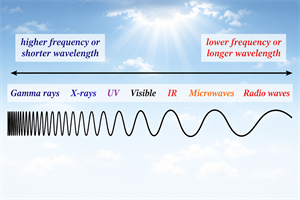
The solar radiation reaching Earth is mainly concentrated in:
- Ultraviolet (UV)
- Visible light
- Infrared (IR)
About \(99\%\) of the Sun’s energy reaching Earth lies mainly in these ranges.
- UV radiation: Much of the short-wavelength UV is absorbed by the ozone layer.
- Visible light: Reaches Earth’s surface and provides energy for photosynthesis and partly warms land and water.
- Infrared radiation: Helps warm Earth’s surface. Some outgoing heat is absorbed by greenhouse gases such as carbon dioxide, methane and water vapour, helping keep Earth warm.
Insolation and solar constant:
The amount of solar radiation reaching Earth’s surface is called insolation. It is responsible for heating Earth’s surface and atmosphere.
The solar constant is the average solar energy received per unit time per unit area perpendicular to the Sun’s rays at the top of Earth’s atmosphere. Its approximate value is:
\(1.4 \ kW \ m^{-2}\) or \(1400\ J\ s^{-1}\ m^{-2}\)
Some solar energy is absorbed or scattered by gases, clouds and dust in the atmosphere. Therefore, the maximum insolation reaching Earth’s surface under clear-sky conditions is about \(1\ kW\ m^{-2}\).
Importance for India:
India receives abundant sunlight because of its location in the tropical and subtropical regions. Solar insolation is important for:
- Driving the southwest monsoon
- Influencing climate and agriculture
- Providing potential for solar energy as a renewable source
Ultraviolet (UV) rays are a type of electromagnetic radiation with wavelengths between \(100\ nm\) and \(400\ nm\). They have higher energy than visible light.
- Prolonged exposure to UV rays can damage the eyes and skin and increase the risk of cancer.
- UV-protective glasses and sunscreen can help protect against excessive UV exposure.
- UV rays are also useful because they can kill germs in water purifiers.
- They are also used to help power fluorescent lights.
Anna Mani's contribution:
Anna Mani, an Indian atmospheric scientist, studied and mapped solar insolation across India. Her work, along with S. Rangarajan, contributed to the first insolation atlas of India and helped demonstrate the country's large solar-energy potential.
The amount of solar energy received from the sun is obtained by,
\(E = Intensity × area × time\)\( \)
- \(E\) \(=\) Total solar energy received (Joules,\( J\))
- Intensity \((I)\) \(=\) Solar energy received per unit area per unit time \((W/m^{2})\)
- Area \((A)\) \(=\) Surface area receiving sunlight \((m^{2})\)
- Time \((t)\) \(=\) Duration for which sunlight falls on the surface (seconds)