

Solar radiation is the main source of energy on Earth. Different surfaces and different latitudes receive and absorb this energy differently, leading to uneven heating of the Earth's surface.
Interaction of Solar Radiation on the Earth's surface:
Different materials absorb and reflect solar radiation differently. Dark-coloured surfaces absorb more sunlight and heat up faster, while light-coloured surfaces reflect more sunlight and remain comparatively cooler. The fraction of solar radiation reflected by a surface is called its albedo.
- High albedo surfaces (snow and ice) reflect most incoming solar radiation and remain cool.
- Low albedo surfaces (black soil and ocean water) absorb more solar radiation and become warmer.
- All objects re-radiate absorbed heat. Concrete buildings and roads release stored heat during the night, making cities warmer.
- Traditional mud and wooden houses remain cooler because they absorb and re-radiate less heat.
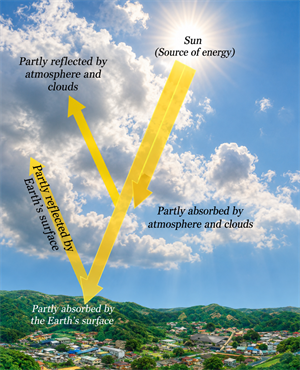
Solar radiation and warming of the Earth
Urban Heat Island effect:
Cities are often warmer than nearby rural areas because materials such as concrete, asphalt, brick and steel absorb and store large amounts of solar energy. The heat re-radiated from these surfaces increases local temperatures, especially at night. In contrast, vegetation in rural areas provides shade and cooling through transpiration.
Latitude and Earth's shape:
Because the Earth is spherical, the Sun's rays strike different latitudes at different angles.
- Near the Equator, solar radiation is concentrated over a smaller area, resulting in greater heating.
- Near the poles, solar radiation is spread over a larger area, resulting in less heating.
- Therefore, equatorial regions remain warm throughout the year, while polar regions remain much colder.
The Earth's spherical shape and the tilt of its axis also cause seasons and changes in the length of daytime during the year.