

In many situations, such as preparing ORS, a specific amount of salt and sugar is added to a fixed quantity of water. If the amount of salt or sugar is changed, or if the volume of water is altered, the solution formed will no longer be ORS. This shows that using the correct proportion of substances is very important.
The amount of solute dissolved in a given amount of solvent or solution is called the concentration of a solution. It helps us understand whether a solution is dilute or concentrated and plays an important role in everyday life as well as in science.
The Concentration of a Solution:
The concentration of a solution is the amount of solute present in a given amount of solvent or solution. Thus, the proportions of solute and solvent present in a solution determine the concentration of the solution.
Dilute and concentrated solutions:
Depending on the amount of solute in the solution, it may be called a dilute or concentrated solution.
1. Dilute solution: A dilute solution contains a small amount of solute in a given amount of solvent .
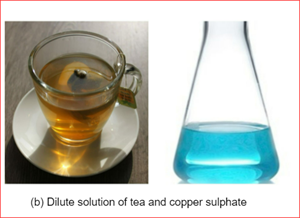
Dilute solution
2. Concentrated solution: A concentrated solution contains a large amount of solute in a given amount of solvent .
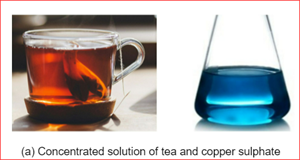
Concentrated solution
The distinction between dilute and concentrated solutions is qualitative. It does not give the exact amount of solute present and is often observed through physical properties such as colour, density, etc.
To express concentration more accurately, quantitative methods are used.
Methods of Expressing Concentration:
The concentration of a solution can be expressed mathematically as:
The concentration of a solution can be expressed using the following methods:
| \(\text{Concentration of solution}\) \(=\) \(\frac{\text{Amount of solute}} {\text{Amount of solvent or solution}}\) |
The concentration of a solution can be expressed using the following methods:
- Mass by mass percentage
- Mass by volume percentage
- Volume by volume percentage
1. Mass by mass percentage (\(\%\) m/m) or (\(\%\) w/w)
We can find the mass percentage of a solution by dividing the mass of solute by the mass of the solution and multiply the product by \(100\).
| Mass by mass percentage \(=\) \(\frac{\text{Mass of solute}}{\text{Mass of solution}}\) \(\times100\) |
The mass percentage is commonly expressed as \(w/w\) (weight / weight)
Similarly, the concentration of solution in ointments, antacids, soaps, and other products is expressed as w/w.
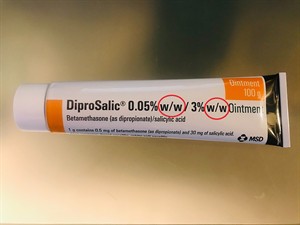
Ointment
2. Mass by volume percentage (\(\%\) m/v) or (\(\%\) w/v)
We can find the mass volume percentage of a solution by dividing the mass of solute by the volume of solution and multiply the product by \(100\).
| Mass by volume percentage \(=\) \(\frac{\text{Mass of solute}}{\text{Volume of solution}}\)\(\times100\) |
3. Volume by volume percentage (\(\%\) v/v)
We can find the volume percentage of a solution by dividing the volume of solute by the volume of solution and multiply the product by \(100\).
|
Volume by volume percentage \(=\) \(\frac{\text{Volume of solute}}{\text{Volume of solution}}\)\(\times100\)
|
Volume percentage is commonly expressed as \(v/v\) (volume / volume). In case if both the solute and the solvent are liquids, this method is used.
The concentration of the ingredients is expressed as \(v/v\) in commercial products that we come across in our daily lives, such as syrup solutions, mouthwash, antiseptic solutions, household disinfectants, and so on.
Comparison of the three methods:
| Method | Solute measured in | Solution measured in | Used for |
|---|---|---|---|
| Mass by Mass (\(\%\) w/w) | \(grams\) | \(grams\) | Solid \(+\) solid or solid \(+\) liquid |
| Mass by Volume (\(\%\) w/v) | \(grams\) | \(mL\) | Solid in liquid |
| Volume by Volume (\(\%\) v/v) | \(mL\) | \(mL\) | Liquid in liquid |