

Words like "pure" are often printed on packets of honey, milk, ghee, and coconut oil. In everyday language, this suggests that the product is natural or free from added impurities. However, in scientific terms, these substances are not considered pure.
For example, milk is made up of several different components such as fats, proteins, lactose (a type of sugar), minerals, vitamins, and water. Since it contains more than one type of substance physically combined together, it is classified as a mixture. Similarly, honey, ghee, and coconut oil also consist of multiple components.
In science, the term "pure substance" has a specific meaning. A substance is said to be pure when it contains only one type of particle throughout and has a fixed composition and definite properties.
From this understanding, matter can be broadly classified based on its composition into two categories: pure substances and mixtures.
Mixtures are classified as homogeneous and heterogeneous mixtures.
i. A homogeneous mixture has a uniform composition throughout. Its components cannot be distinguished easily. Examples include salt solution, sugar solution, vinegar and air.
ii. A heterogeneous mixture has a non-uniform composition. The different components are not evenly distributed throughout the mixture and can often be seen separately. Examples include sand and water, oil and water, soil, colloids (such as milk and fog), and suspensions (such as muddy water and chalk powder in water).
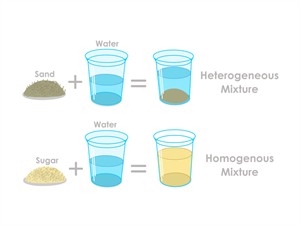
Types of mixtures
Solution:
A solution is a homogeneous mixture in which one substance dissolves in another. The substance that dissolves is called the solute, while the substance in which it dissolves is called the solvent. For example, in a salt solution, salt is the solute and water is the solvent.
The Concentration of a Solution:
The concentration of a solution is the amount of solute present in a given amount of solvent or solution. Thus, the proportions of solute and solvent present in a solution determine the concentration of the solution.
Concentration can be expressed in different ways:
1. Mass by mass percentage.
We can find the mass percentage of a solution by dividing the mass of solute by the mass of the solution and multiply the product by \(100\).
| Mass by mass percentage \(=\) \(\frac{\text{Mass of solute}}{\text{Mass of solution}}\) \(\times100\) |
2. Mass by volume percentage.
We can find the mass volume percentage of a solution by dividing the mass of solute by the volume of solution and multiply the product by \(100\).
| Mass by volume percentage \(=\) \(\frac{\text{Mass of solute}}{\text{Volume of solution}}\)\(\times100\) |
3. Volume by volume percentage.
We can find the volume percentage of a solution by dividing the volume of solute by the volume of solution and multiply the product by \(100\).
|
Volume by volume percentage \(=\) \(\frac{\text{Volume of solute}}{\text{Volume of solution}}\)\(\times100\)
|
Solubility of a Substance:
Different substances dissolve in different amounts in the same solvent. The maximum amount of solute that can dissolve in a given quantity of solvent at a particular temperature is called its solubility.
A solution containing the maximum amount of dissolved solute at a given temperature is called a saturated solution.
Factors affecting solubility:
The effect of temperature on solubility is different for solids and gases.
- For most solid solutes, solubility increases as temperature increases. Therefore, more sugar dissolves in hot water than in cold water.
- For most gaseous solutes, solubility decreases as temperature increases. Therefore, cold soft drinks retain more dissolved carbon dioxide than warm soft drinks.
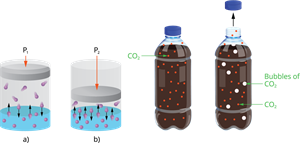
Effect of pressure on solubility
Solubility curve:
A solubility curve is a graph that shows how the solubility of a substance changes with temperature. It helps us understand how much solute can dissolve in water at different temperatures.
In a solubility curve:
- The \(X\)-axis represents temperature (\(°C\))
- The \(Y\)-axis represents solubility (\(g\) of solute in \(100\ g\) of water)
For most solid substances, solubility increases with increase in temperature, which means more solute can dissolve in hot water than in cold water.
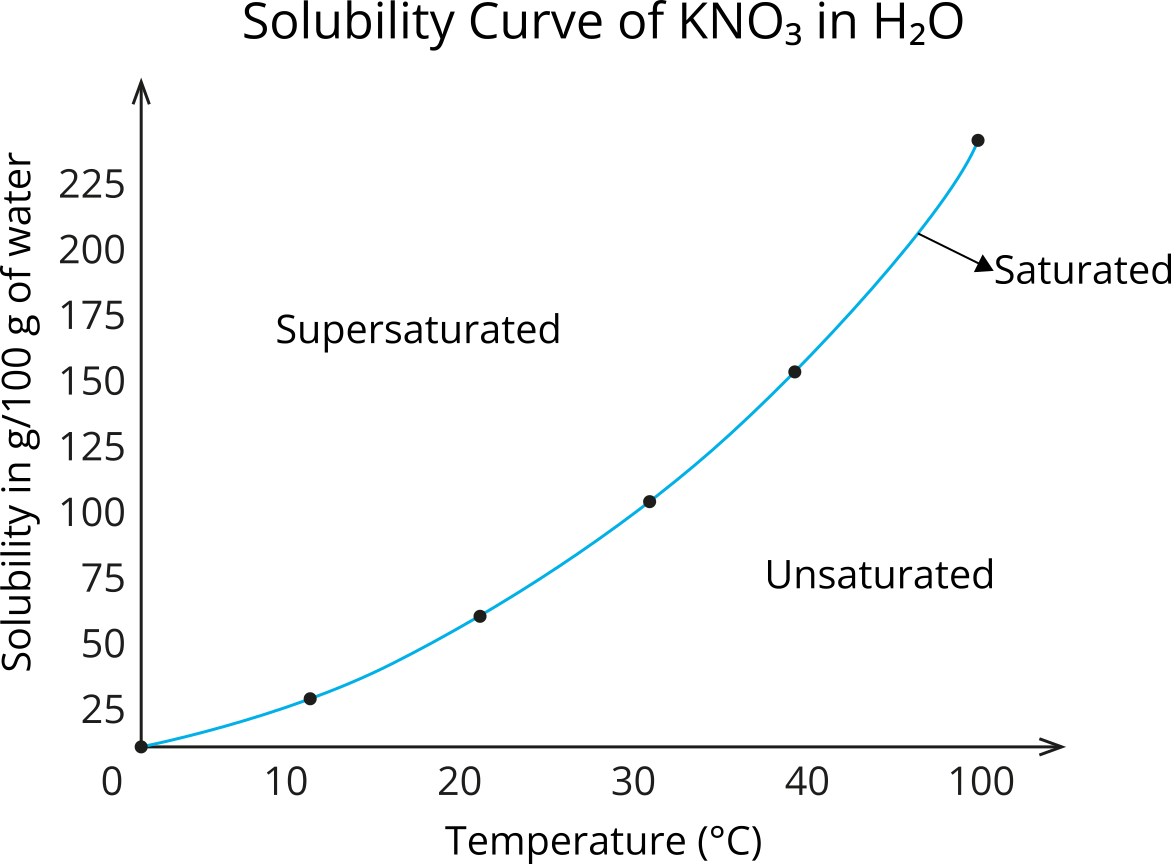
Solubility curve
The differences in solubility and boiling point are useful in separating substances from homogeneous mixtures.
Crystallisation:
Crystallisation is a method used to obtain a pure solid from its saturated solution. It is based on the principle that the solubility of many solids changes with temperature. When a hot saturated solution is cooled, the excess dissolved solute separates out as pure crystals. Crystallisation is commonly used to purify substances such as salt, sugar and laboratory chemicals.
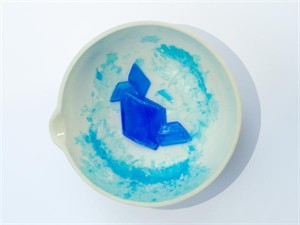
Crystals of copper sulphate after crystallisation
Distillation:
Distillation is a method used to separate a mixture of two miscible liquids whose boiling points differ by at least \(25°C\). It is based on the difference in boiling points of the liquids. During distillation, the liquid with the lower boiling point vaporises first. The vapour is then cooled in a condenser and converted back into liquid, which is collected separately. Distillation is used to separate mixtures such as acetone and water and to obtain pure water from impure water.
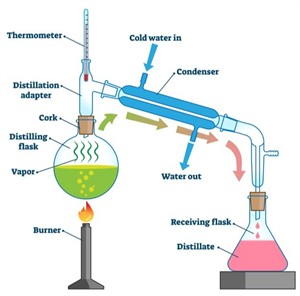
Simple distillation
Paper chromatography:
Another important method of separation is paper chromatography. It is used to separate the components of a mixture based on their different rates of movement on chromatography paper. A small spot of the mixture is placed on the paper, and the lower end of the paper is dipped in a suitable solvent. As the solvent moves upward, the components of the mixture travel at different speeds and separate into distinct spots. Paper chromatography is widely used to separate dyes in ink, identify pigments in plants and analyse mixtures in laboratories.
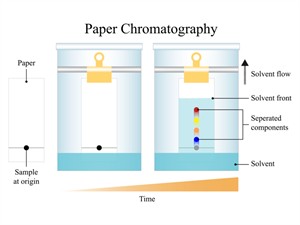
Paper chromatography
Thus, the study of solutions, solubility and separation techniques helps us understand how substances mix and how useful components can be obtained from mixtures.