

A heterogeneous mixture is a mixture in which the components are not uniformly distributed and can often be seen as separate parts.
Properties of heterogeneous mixture:
- All components of the mixture are unevenly distributed.
- There are noticeable separate lines.
- There are two or more phases in the solution.
- Oil and water, sand and water, salad are examples.
- Non-uniform mixtures are also called heterogeneous mixtures.
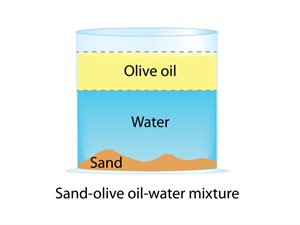
Heterogeneous mixture
Suspensions:
You may have played with mud during your childhood. Have you ever wondered what happens when mud is added to water? Does it dissolve?
When mud is mixed with water, it does not dissolve. Instead, the particles remain undissolved and settle down after some time. Such a mixture is called a suspension.
A suspension is a heterogeneous mixture in which the particles do not dissolve and settle down entirely in the medium.
Example: Clay mixture with water, flour in water, and mixture of chalk and water.
Properties of suspension:
i. Suspension is a heterogeneous mixture.
ii. The particles are relatively large, usually greater than \(1000\) \(nm\) in diameter, and can be seen with the naked eye.
iii. Suspension particles scatter a beam of light passing through it and make its path visible.
Note: When the suspended particles settle down, the beam of light is not scattered.
iv. When left undisturbed, the particles settle down due to gravity. This process is called sedimentation, showing that suspensions are unstable.
v. The particles can be separated from the medium by filtration.
Separation techniques of two immiscible liquids:
The oil and water form separate layers. They do not mix and are called immiscible liquids. Similarly, sand and water do not mix. These are examples of heterogeneous mixtures.
Separating funnel technique:
According to the principle, immiscible liquids separate into layers based on their densities. Separatory funnels, also known as separation funnels, are popular in chemistry laboratories. Immiscible liquids are separated from their solutes using these funnels.
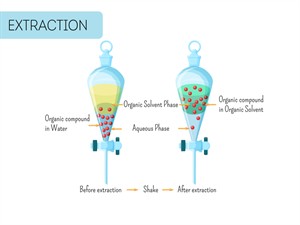
Separating funnel
Separation of kerosene and water:
Let us see, if we can separate kerosene oil from water.
- Step 1: In a separating funnel, pour the kerosene oil and water mixture.
- Step 2: Allow it to sit undisturbed for a while to form separate layers of oil and water.
- Step 3: Open the separating funnel stopcock and carefully drain out the lower layer of water.
- Step 4: As soon as the oil enters the separating funnel stopcock, close it.
Observation: We can find two different layers of liquids, the heterogeneous liquids.
Sublimation:
Principle:
Sublimation is based on the difference in the ability of substances to change directly from solid to gas on heating.
Process:
When a mixture contains a sublimable solid and a non-sublimable solid, it is heated. The sublimable substance changes directly into vapour and then condenses on a cooler surface to form solid crystals, while the non-sublimable substance remains behind in the container.
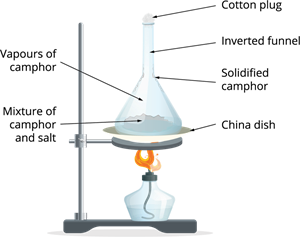
Sublimation
Example: A mixture of camphor and salt can be separated by sublimation. On heating, camphor sublimes and gets deposited as crystals on the cooler surface, while salt remains at the bottom of the container. Ammonium chloride, naphthalene, and iodine are a few examples of solids that undergo sublimation.
Colloids:
In everyday life, the products we use, such as mayonnaise, jelly, and butter are the colloidal solution.
A colloidal solution is a heterogeneous mixture. In the colloidal solution, the particles of a colloid uniformly spread throughout the solution.
A colloid is a type of mixture that has properties between those of a solution and a suspension. Colloids can be identified by the Tyndall effect, which is the scattering of light when it passes through a colloidal solution.
Example: Milk, hair cream, toothpaste, fog, cheese, butter and paint
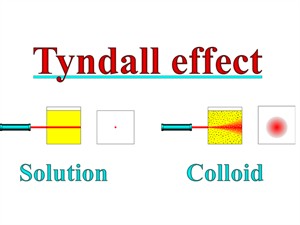
Tyndall effect on colloids
Properties of colloidal solution:
i. Colloidal solution is a heterogeneous mixture.
ii. A colloidal solution contains finely divided particles whose size ranges between \(1\ nm\) and \(1000\ nm\).
iii. Colloidal particles can scatter a beam of light passing through it and make its path visible.
iv. A colloidal solution is quite stable so that it does not settle down when left undisturbed.
v. These particles are small enough to pass through filter paper, so they cannot be separated by filtration.
vi. The particles in a colloidal solution can be separated by the process of centrifugation.
Types of colloidal solutions:
Classification of colloids based on the physical state of the dispersed phase and dispersion medium.
a. Dispersed phase: The dispersed phase is described as a phase that is scattered or present in the form of colloidal particles.
b. Dispersed medium: The dispersed phase is the medium in which colloidal particles are distributed.
|
S.No
|
Name
|
Dispersed phase
|
Dispersed medium
|
Example
|
|
1.
|
Solid sol
|
Solid
|
Solid
|
Colored glass, Gems, Alloys.
|
|
2.
|
Sol
|
Solid
|
Liquid
|
Paint, Fruit jellies, Dye, Ink, Egg white
|
|
3.
|
Aerosol
|
Solid
|
Gas
|
Smoke
|
|
4.
|
Gel
|
Liquid
|
Solid
|
Cheese, Butter.
|
|
5.
|
Emulsion
|
Liquid
|
Liquid
|
Milk, Oil in water, Mayonnaise, Face cream.
|
|
6.
|
Aerosol
|
Liquid
|
Gas
|
Fog, Mist, Clouds, Body sprays.
|
|
7.
|
Foam
|
Gas
|
Liquid
|
Soap lather, Shaving cream, Coffee froth
|
|
8.
|
Solid foam
|
Gas
|
Solid
|
Rubber, Sponge, Cake, Bread
|
Separation techniques are based on differences in physical properties of the components of a mixture, These properties include differences in solubility, boiling point, density, particle size, magnetic nature, and adsorption behaviour. By making use of these differences, the components of a mixture can be separated without bringing about any chemical change in them.
Centrifugation:
Sometimes, very fine particles remain suspended in a liquid and cannot be separated by filtration. In such cases, centrifugation is used.
Principle:
Centrifugation is based on the difference in density of particles in a mixture. Heavier particles settle faster when the mixture is spun at high speed.
Process:
The mixture is placed in test tubes and rotated rapidly in a centrifuge. Heavier particles move outward and settle at the bottom as sediment, while the lighter liquid remains above as supernatant.
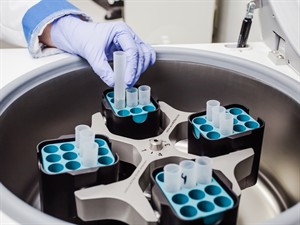
Centrifugation instrument
Coagulation:
Principle:
Coagulation is based on the aggregation of fine suspended particles into larger particles, which can settle due to gravity.
Process:
Take some muddy water in a beaker and add a small piece of alum to it. Stir the mixture gently so that the alum gets evenly distributed throughout the water.
After some time, the fine suspended particles begin to stick together and form larger, heavier particles. These particles settle down at the bottom of the beaker, leaving clear water above. The clear water can then be separated by carefully decanting or by filtration. In this way, muddy water is purified using coagulation.
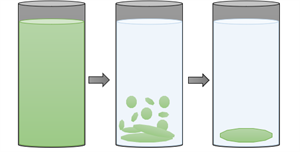
Coagulation
Example: In rural areas, alum is sometimes added to muddy pond water to make suspended dirt settle down.
Reference:
https://commons.wikimedia.org/wiki/File:Floculaci%C3%B3n.png