

Suspensions:
Let us take a container filled with muddy water and observe it carefully. When the mixture is stirred, the solid particles can be clearly seen moving in the liquid. This is different from a true solution, where the solute particles dissolve completely and cannot be seen.
Such mixtures, in which insoluble solid particles remain dispersed throughout a liquid, are called suspensions. A suspension is a heterogeneous mixture because its composition is not uniform throughout.
In a suspension:
- The particles do not dissolve in the liquid.
- They are large enough to be seen with the naked eye.
- The particles are heavier than the liquid medium.
- When left undisturbed, they settle down at the bottom due to gravity. This process is called sedimentation.
Examples: Muddy water, chalk powder in water, sawdust in water.
Separation of Suspensions:
Larger particles in a suspension can be separated by sedimentation and decantation or by filtration. However, very fine particles may not settle easily and can even pass through filter paper. In such cases, special techniques like centrifugation and coagulation are used.
Centrifugation:
Centrifugation is a technique used to separate very fine particles that do not settle down under the influence of gravity.
Principle:
Centrifugation is based on the difference in density of particles in a mixture. Heavier particles settle faster when the mixture is spun at high speed, due to centrifugal force.
Steps involved in this method:
- The suspension is taken in test tubes or containers.
- These tubes are placed in a centrifuge machine in a balanced manner.
- The centrifuge is switched on and rotated at very high speed.
- Due to rapid spinning, a strong outward force (centrifugal force) is produced.
- Heavier solid particles are pushed outward and settle at the bottom of the tube.
- The clear liquid (supernatant) remains on the top and can be separated easily.
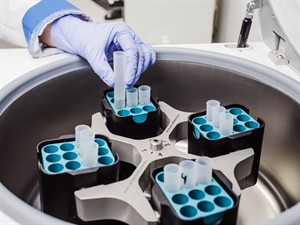
Centrifugation instrument
Example: If you cross your arms with a friend and spin around, your arms move outward. This happens due to centrifugal force. Similarly, particles in a centrifuge move outward and separate.
Applications:
- It is used to separate cream from milk.
- It is used in diagnostic laboratories for analysing blood and urine samples.
- It is used in blood banks to separate various components of blood.
- It is used in washing machines to remove water from wet clothes
Coagulation:
Coagulation is a method used to separate very fine particles by making them combine into larger particles.
Principle:
Coagulation is based on the aggregation of fine suspended particles into larger particles, which can settle due to gravity.
Steps involved in this method:
- A chemical substance called a coagulant (such as alum or fitkari) is added to the suspension.
- The coagulant neutralizes the forces keeping the particles apart.
- As a result, the tiny particles combine to form larger clumps called flocs.
- These heavier flocs settle down at the bottom of the container.
- The clear liquid can then be separated easily by decantation or filtration.
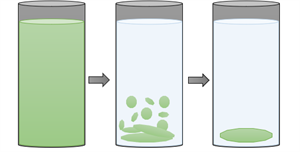
Coagulation
Example: In rural areas, alum is sometimes added to muddy pond water to make suspended dirt settle down.
Application:
- Purification of drinking water
- Wastewater treatment
- Clarification of turbid water in industries
Note:
Very fine suspended particles remain dispersed in a liquid for a long time and cannot be separated by simple methods like sedimentation or filtration. Centrifugation helps by applying rapid spinning, while coagulation helps by combining small particles into larger ones, making separation easier.
Very fine suspended particles remain dispersed in a liquid for a long time and cannot be separated by simple methods like sedimentation or filtration. Centrifugation helps by applying rapid spinning, while coagulation helps by combining small particles into larger ones, making separation easier.
Reference:
https://commons.wikimedia.org/wiki/File:Floculaci%C3%B3n.png