

Some mixtures cannot be separated using basic methods like filtration, evaporation, or handpicking. For such mixtures, special techniques are used based on the physical properties of the substances present. These techniques include sublimation, centrifugation, and coagulation.
Sublimation:
A mixture of ammonium chloride and sand is heated. What do you think will happen to ammonium chloride?
Some solids change directly into vapour on heating without becoming liquid. This property is called sublimation.
Principle:
Sublimation is based on the difference in the ability of substances to change directly from solid to gas on heating.
Process:
When a mixture contains a sublimable solid and a non-sublimable solid, it is heated. The sublimable substance changes directly into vapour and then condenses on a cooler surface to form solid crystals, while the non-sublimable substance remains behind in the container.
Example:
A mixture of camphor and salt can be separated by sublimation. On heating, camphor sublimes and gets deposited as crystals on the cooler surface, while salt remains at the bottom of the container. Ammonium chloride, naphthalene, and iodine are a few examples of solids that undergo sublimation.
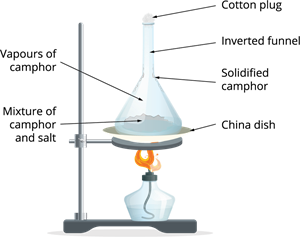
Sublimation process
Applications:
- Purification of ammonium chloride
- Purification of camphor and naphthalene
- Laboratory separation of volatile solids
Centrifugation:
Milk appears uniform, but it contains tiny fat globules. How can we separate cream from milk?
Sometimes, very fine particles remain suspended in a liquid and cannot be separated by filtration. In such cases, centrifugation is used.
Principle:
Centrifugation is based on the difference in density of particles in a mixture. Heavier particles settle faster when the mixture is spun at high speed.
Process:
The mixture is placed in test tubes and rotated rapidly in a centrifuge. Heavier particles move outward and settle at the bottom as sediment, while the lighter liquid remains above as supernatant.
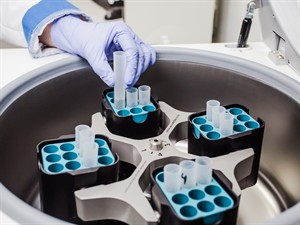
Centrifugation instrument
Example:
Take fresh milk in centrifuge tubes and place them in a centrifuge machine. Rotate the tubes at high speed. Due to rapid spinning, the heavier liquid (skimmed milk) moves outward and collects at the bottom of the tube, while the lighter fat particles (cream) collect at the top. The cream is then carefully separated from the milk. In this way, cream is separated from milk using centrifugation.
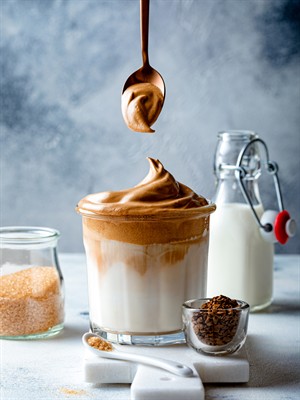
The denser particles remains at the bottom and lighter one floats
Applications:
- It is used to separate cream from milk.
- It is used in diagnostic laboratories for analysing blood and urine samples.
- It is used in blood banks to separate various components of blood.
- It is used in washing machines to remove water from wet clothes.
Coagulation:
Why does muddy water become clear when alum is added to it?
Some impurities in water are extremely fine and remain suspended. These can be removed by coagulation.
Principle:
Coagulation is based on the aggregation of fine suspended particles into larger particles, which can settle due to gravity.
Process:
Take some muddy water in a beaker and add a small piece of alum to it. Stir the mixture gently so that the alum gets evenly distributed throughout the water.
After some time, the fine suspended particles begin to stick together and form larger, heavier particles. These particles settle down at the bottom of the beaker, leaving clear water above. The clear water can then be separated by carefully decanting or by filtration. In this way, muddy water is purified using coagulation.
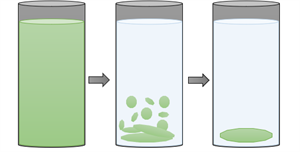
Coagulation
Example: In rural areas, alum is sometimes added to muddy pond water to make suspended dirt settle down.
Application:
- Purification of drinking water
- Wastewater treatment
- Clarification of turbid water in industries
Safety precautions in seperation techniques:
- Handle chemicals like alum carefully as it may cause irritation to skin or eyes on direct contact.
- Do not inhale vapours during heating as they may be harmful or irritating to the respiratory system.
- Balance centrifuge tubes properly as uneven tubes can cause vibration, damage to the centrifuge, or accidents.
- Use protective equipment when required (gloves, goggles) as they protect eyes and skin from chemical splashes and heat.
- Handle hot apparatus with care as heated equipment can cause burns or injuries on contact.
Reference:
https://commons.wikimedia.org/wiki/File:Floculaci%C3%B3n.png