

J. J. Thomson introduced an atom model, which helped in laying the foundation for further research in the atomic model. Significantly, the research on the atomic model was done by Rutherford.
Rutherford Model:
Ernest Rutherford was curious about the arrangement of electrons in an atom. He designed an experiment in which high-energy alpha particles (\(He^{2+}\)) were used to fall on a thin gold foil. This experiment is also known as the alpha particle scattering experiment.
Observation:
- Since most alpha particles passed through the gold foil without being deflected, most of the space inside the atom is empty.
- Only a few particles were deflected from their direction, suggesting that the atom's positive charge uses very little space.
- Just a small percentage of alpha particles were deflected by \(180°\), showing that the gold atom's positive charge and mass were concentrated in a very small volume within it.
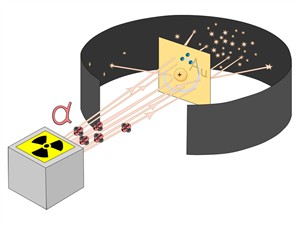
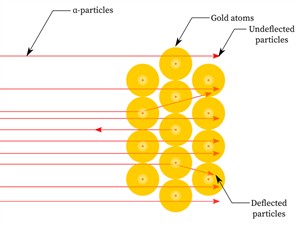
Scattering of \(\alpha\)-particles by a gold foil
Features of the atom:
- The positive center of the atom is known as the nucleus.
- All the mass is concentrated on the nucleus, around which the electrons circulate in the well-defined orbit, much like planets revolving around the Sun. Hence, Rutherford's model is often called the planetary model of the atom.
- The size of the nucleus is less than the atom.
-
Rutherford found that the nucleus is extremely small compared to the size of the atom.
- Diameter of an atom = \(10^{-10}\) \(m\)
- Diameter of the nucleus = \(10^{-15}\) \(m\)
This means the nucleus occupies only a tiny fraction of the atom. If an atom were enlarged to the size of a large stadium, the nucleus would be only about the size of a small marble at the centre.
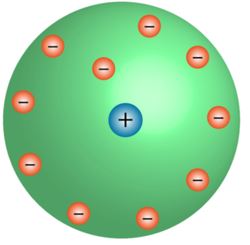
Rutherford's model of an atom
Drawbacks of Rutherford's atomic model:
As electrons revolve in orbit, they accelerate and lose energy. Thereafter, they fall into the nucleus. If this happened, the atom would collapse and matter would no longer exist. Thus, Rutherford's model failed to explain the stability of the atom.
To overcome the drawbacks of Rutherford's model, Neil Bohr proposed a new atomic model.
Bohr's model of the atom:
To explain why atoms are stable, Niels Bohr proposed a new model of the atom in \(1913\).
According to Bohr:
- The electrons revolve around the nucleus in a specific orbit, and these orbits are associated with definite energies called shells or energy levels or stationary states.
- The electrons do not emit energy when revolving in specific orbits.
These shells, or energy levels, or orbits, are represented by the letters K, L, M, N or by the numbers \(1, 2, 3, 4\).
The K-shell is nearest to the nucleus and has the least energy. As the distance from the nucleus increases, the energy of the shells also increases.
Hence, the energy level or size of the shells are given by:
\(K < L < M < N\)
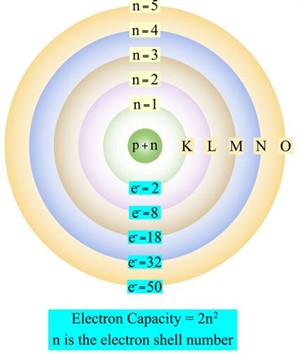
Bohr's atom model (electron shell diagram)
What Components Contribute to the Mass of an Atom?
The mass of atoms could not be explained by protons alone. For example, helium \(\) has only twice as many protons as hydrogen \(\), but its mass is about four times greater. This suggested that another particle must be present in the nucleus.
Discovery of the Neutron:
In \(1932\), the British physicist James Chadwick discovered a new subatomic particle called the neutron. Through his experiments, he found that the nucleus contains a particle that has no electrical charge and a mass nearly equal to that of a proton. This discovery helped explain the mass of atoms more accurately and improved scientists' understanding of atomic structure.
The Three Subatomic Particles:
Atoms are made up of three fundamental particles.
|
Subatomic particles
|
Scientists name
|
Symbol
|
Charge
|
Mass (\(amu\)) | Location |
|
Electrons
|
J. J. Thomson
|
\(e^−\)
|
\(−1\)
|
\(0\)
|
Outside the nucleus
|
|
Protons
|
Ernest Rutherford
|
\(p^+\)
|
\(+1\)
|
\(1\)
|
Inside the nucleus
|
|
Neutron
|
James Chadwick
|
\(n^0\)
|
No charge
|
\(1\)
|
Inside the nucleus
|
Why do larger atoms need more neutrons?
Protons in the nucleus repel each other because they have the same positive charge. Neutrons help keep the nucleus stable, so larger atoms require more neutrons than smaller atoms.