

Imagine atoms as the rooms of a house. One room is different from the other. Each and every room, the bedroom, kitchen, and living room, has its own size, design, and purpose. But together, they make a complete home. Similarly, atoms are tiny units with their own features, and when they join, they form complete substances.

Rooms of a home
Symbols of elements:
- John Dalton was the first scientist to use symbols to represent elements, but his symbols were pictorial, not letter-based.
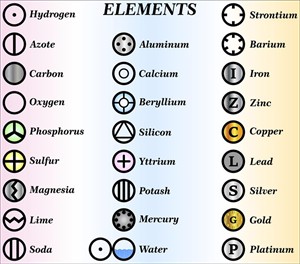
Symbols to represent elements
- Jöns Jacob Berzelius, a Swedish chemist, later introduced the modern system of chemical symbols, using one or two letters derived from the element's English or Latin name.
We can see that each element has a name and a unique chemical symbol. Some elements' symbols are made up of the first letter of the name and a letter that appears later in the name.
Example:
i. Hydrogen - \(H\)
ii. Magnesium - \(Mg\)
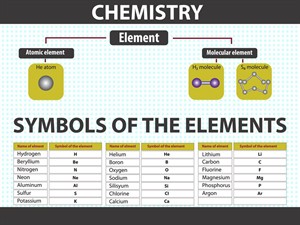
Elements and its symbols
Some elements have names derived from Greek or Latin, so their symbols may differ from their English names.
Example:
i. The symbol of iron is \(Fe\) from its Latin name Ferrum (\(Fe\)).
ii. Potassium symbol is \(K\) from Kalium (\(K\)).
iii. Sodium is \(Na\) from Natrium (\(Na\)).
Norms for writing symbols of elements:
- For the most common elements, use the first letter of the English name.
Example: Boron - \(B\), Oxygen - \(O\), Hydrogen - \(H\) - If the name of an element has the same letter as another, use the first and second letter of their English name—the first letter in upper case and the second letter in lower case.
Example: Barium - \(Ba\), Sodium - \(Na\), Lithium - \(Li\) - If the first letter or first two letters of the element is the same as another, use the first and second or third letter of the English name.
Example: Argon - \(Ar\) and Arsenic - \(As\) - Some of the elements are named using the old or Latin name of the element. There are eleven elements. Few of them are listed here.
ElementLatin nameSymbolSodiumNatriumNaPotassiumKaliumKIronFerrumFeCopperCupurumCuGoldAurumAu
Some of the elements are named after the name of country, scientist, colour, mythological character or planet.
|
Americium
|
\(Am\)
|
America (country)
|
|
Europium
|
\(Eu\)
|
Europe (country)
|
|
Nobelium
|
\(No\)
|
Alfred Nobel (scientist)
|
|
Iodine
|
\(I\)
|
Violet (colour, Greek)
|
|
Uranium
|
\(U\)
|
Uranus (planet)
|
Atomic number:
The number of protons in the nucleus of an atom is known as its atomic number. The symbol "\(Z\)" stands for the atomic number. The atom of a different element has a different number of protons.
We can easily calculate the number of electrons or protons in an atom if we know its atomic number.
Let us recall the points for that,
- The number of protons is known as the atomic number.
- In a neutral atom, the number of protons is equal to the number of electrons.
Example:
For carbon, calculate the number of
i. protons and ii. electrons
The atomic number of carbon is \(6\).
We know that the the atomic number is equal to the number of protons.
Hence, the number of protons = \(6\)
In a neutral atom, the number of protons is equal to the number of electrons.
Hence, the number of electrons = \(6\)
Mass number:
The mass number or atomic mass of an atom is equal to the sum of the number of protons and neutrons present in the nucleus. It is represented by the symbol "A"
The atomic number (\(Z\)), mass number (\(A\)), and symbol of an element are written as follows in atomic notation:
Where X is the symbol of an element.
A = Protons + Neutrons
Z = Protons or electrons
Example:
Mass number = \(16\)
Atomic number = \(8\)
By rearranging the atomic mass formula, we can calculate the number of neutrons.
Hence, the number of neutrons = \(16\) - \(8\) = \(8\)
Electrons distribution in different energy levels:
Bohr and Bury proposed the distribution of electrons in orbits.
Bohr's Model:
The definite distribution of electrons around the nucleus is called electronic configuration.
To achieve the electronic configuration, it follows a certain set of rules:
- The formula defines the total number of electrons in a shell.
Where, n is energy level or orbit number. \(n = 1, 2, 3, 4,\) etc. Therefore, the maximum number of electrons in different shells are as follows:
| Energy levels | Shells | Maximum electrons | Electron capacity |
|
1
|
K
|
\(2\)
|
|
|
2
|
L
|
\(8\)
|
|
|
3
|
M
|
\(18\)
|
|
|
4
|
N
|
\(32\)
|
This implies that the first shell (K shell) can have a maximum of two electrons, the second shell (L shell) can have a maximum of eight electrons and so on.
- Unless the inner shells are filled, electrons cannot fill in a given shell. In other words, the shells are gradually filled.
Example:
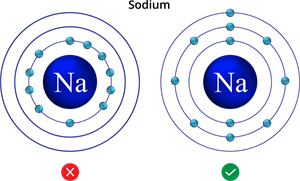
Incorrect and correct filling of electrons in sodium
According to Bohr, the energy of the shell is proportional to its size. The greater the size, the greater the energy. Since the first shell is the smallest, it has the lowest energy, and it gets filled first.
Hence, the energy level or size of the shells are given by:
K < L < M < N
The atomic structure of the first eighteen elements is shown schematically.
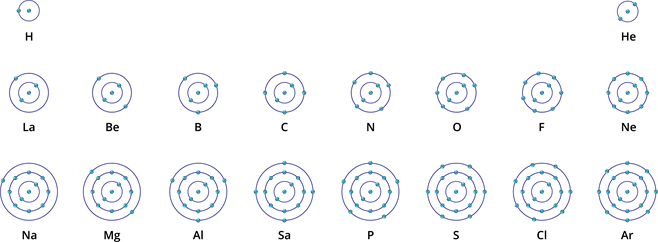
Atomic structure of first eighteen elements