

Have you ever wondered what everything around us is made of, from the air we breathe to the phone in your hand? Whether it’s the food we eat or the clothes we wear, everything is made up of matter.
For example, when water boils and turns into steam, nothing is lost! The same matter simply changes its form. This simple idea leads to two big concepts in chemistry:
-
Everything in the universe is made of matter.
-
Atoms are the smallest particles of elements that cannot be broken down chemically.
These ideas form the basis of all chemical studies and discoveries.
Historical background:
These fundamental ideas about matter and atoms were not discovered overnight. Long before modern science, ancient Indian and Greek philosophers had already begun questioning what matter is made of and how small its particles could be.
-
Around \(500\) BC, the Indian philosopher Acharya Kanada proposed that if we go on dividing matter, we will ultimately get very small particles called Parmanu (atoms).
-
Around the same time, Greek philosophers Democritus and Leucippus suggested that matter is made of tiny indivisible particles called atoms (meaning “indivisible”).
However, these were only philosophical ideas, not proven by experiments. It was only after the 18th century that scientists began experimenting and proved the existence of atoms. Scientists later began performing experiments to test these ideas about atoms. These experiments led to the discovery of subatomic particles.
Discovery of subatomic particles:
Scientists discovered a phenomenon called radioactivity, which showed that atoms are not indivisible and are made of smaller particles.
In 1897, J. J. Thomson conducted experiments using a discharge tube containing gases at very low pressure and applied high voltage across the electrodes. He observed rays called cathode rays moving from the cathode to the anode.
By studying these rays, Thomson concluded that they were made of negatively charged particles called electrons. This proved that atoms contain smaller subatomic particles. The charge of an electron is taken as \(–1\).
The discovery of electrons created a new question: if atoms contain negatively charged particles, how are atoms overall neutral?
Thomson's model of atom:
After discovering negatively charged particles called electrons, J. J. Thomson wondered how atoms remain neutral. To explain this, he proposed the Plum Pudding Model.
According to this model:
- The atom is a sphere of positive charge.
- Negatively charged electrons are embedded throughout the sphere.
- The total positive and negative charges balance each other, making the atom neutral.
This model was compared to a plum pudding or a watermelon, where the positive charge is spread evenly like the pulp and the electrons are like seeds scattered inside it.
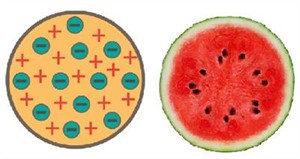
Thomson's model of atom
Rutherford's gold foil experiment:
In 1911, Geiger and Marsden, under the guidance of Ernest Rutherford, performed the famous Gold Foil Experiment to test Thomson’s model of the atom.
Experiment:
- A narrow beam of alpha particles (\(α\)-particles) was directed at a very thin sheet of gold foil.
- Alpha particles are tiny positively charged particles containing two protons and two neutrons.
- According to Thomson’s model, the particles should pass straight through or show only slight deflection because the positive charge was spread evenly throughout the atom.
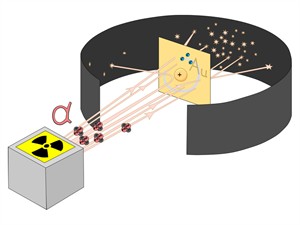
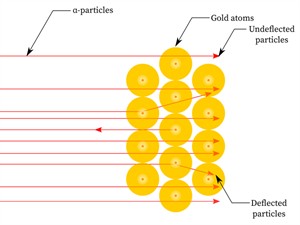
Scattering of alpha ray particles
Observations:
- Most \(α\)-particles passed straight through the foil.
- Some particles were deflected slightly.
- A very few particles were deflected through large angles or even bounced back.
The deflection of α-particles from their straight path is called scattering. Hence, the experiment is also known as the α-ray scattering experiment.
Why Thomson’s Model Failed?
Thomson’s model could not explain:
- Why most α-particles passed through undeflected.
- Why a few α-particles were deflected sharply or bounced back.
This showed that the positive charge was not spread evenly throughout the atom, leading to Rutherford’s new atomic model.