

Historical background:
The concept of atoms was not discovered overnight. Long before modern science, ancient Indian and Greek philosophers wondered what matter is made of and how small its particles could be.
- Around \(500\) \(BC\), the Indian philosopher Acharya Kanada proposed that if matter is divided continuously, it would eventually reach extremely small indivisible particles called Parmanu.
- Around the same time, the Greek philosophers Democritus and Leucippus suggested that matter is made up of tiny indivisible particles called atoms, derived from the Greek word atomos, meaning "indivisible."
Many centuries later, John Dalton proposed his atomic theory, stating that atoms are indivisible and cannot be created or destroyed during chemical reactions.
However, later experiments proved that atoms are divisible and contain smaller particles called subatomic particles.
Discovery of the electron:
In \(1897\), J. J. Thomson performed experiments using a discharge tube containing gas at very low pressure. When a high voltage was applied across the electrodes, he observed cathode rays travelling from the cathode to the anode.
From these experiments, Thomson concluded that cathode rays consist of negatively charged particles called electrons. This was the first evidence that atoms contain subatomic particles. The charge of an electron is \(–1\).
The discovery of electrons created a new question: if atoms contain negatively charged particles, how are atoms overall neutral?
Thomson's model of atom (Plum pudding model):
To explain the neutrality of atoms, Thomson proposed the Plum Pudding Model.
According to this model:
- The atom is a sphere of positive charge.
- Negatively charged electrons are embedded throughout the sphere.
- The total positive and negative charges balance each other, making the atom neutral.
This model was compared to a plum pudding or a watermelon, where the positive charge is spread evenly like the pulp and the electrons are like seeds scattered inside it.
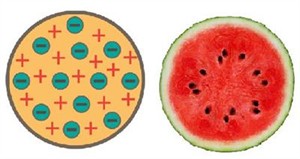
Thomson's model of atom
Rutherford's gold foil experiment:
In 1911, Geiger and Marsden, under the guidance of Ernest Rutherford, performed the famous Gold Foil Experiment to test Thomson’s model of the atom.
Experiment:
- A narrow beam of alpha particles (\(α\)-particles) was directed at a very thin sheet of gold foil.
- Alpha particles are tiny positively charged particles containing two protons and two neutrons.
- According to Thomson's model, most particles were expected to pass through the foil with only slight deflection.
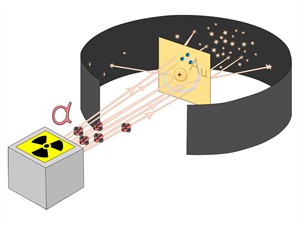
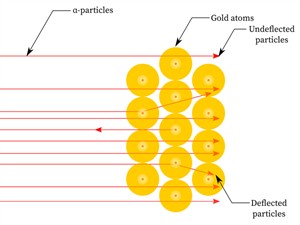
Scattering of alpha ray particles
Observations:
- Most \(α\)-particles passed straight through the foil.
- Some particles were deflected through small angles.
- A very few particles were deflected through large angles or even bounced back.
The deflection of α-particles from their straight path is called scattering. Hence, the experiment is also known as the α-ray scattering experiment.
Why Thomson’s Model Failed?
Thomson’s model could not explain:
- Why most α-particles passed through undeflected.
- Why a few α-particles were deflected sharply or bounced back.
This showed that the positive charge was not spread evenly throughout the atom, leading to Rutherford’s new atomic model.
Rutherford's Atomic Model:
Based on the experiment, Rutherford proposed the following:
- Most of the atom is empty space, since most α-particles passed through without any deflection.
- The positive charge and almost all the mass are concentrated in a tiny central region called the nucleus.
- Electrons revolve around the nucleus in fixed paths, similar to planets revolving around the Sun. Hence, it is also called the planetary model.
The nucleus is extremely small compared to the atom.
- Diameter of an atom = \(10^{-10}\) \(m\)
- Diameter of the nucleus = \(10^{-15}\) \(m\)
If an atom were the size of a large stadium, the nucleus would be about the size of a small marble at its centre.
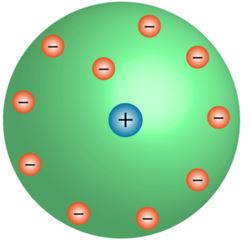
Rutherford's model of an atom
Drawback of Rutherford's Model:
According to classical physics, revolving electrons should continuously lose energy and eventually fall into the nucleus. If this happened, atoms would collapse. Therefore, Rutherford's model could not explain the stability of atoms.
Bohr's Model of the atom:
To overcome this drawback, Niels Bohr proposed a new atomic model in \(1913\).
According to Bohr:
- Electrons revolve around the nucleus only in fixed energy levels (shells) called stationary states.
- While moving in these shells, electrons do not lose energy.
The shells are represented as\(\ K, L, M, N\) or n = \(1, 2, 3, 4\).
- The K-shell is closest to the nucleus and has the least energy.
- As the distance from the nucleus increases, the energy also increases.
Hence,
K < L < M < N
Discovery of the Neutron:
Although protons explained the positive charge of the nucleus, they could not account for the total mass of atoms. For example, helium has twice as many protons as hydrogen but about four times its mass.
In\(\ 1932\), James Chadwick discovered the neutron, a particle with no charge and a mass nearly equal to that of a proton. This discovery explained the mass of atoms more accurately.
The three subatomic particles:
|
Subatomic particles
|
Scientists name
|
Symbol
|
Charge
|
Mass (\(amu\)) | Location |
|
Electrons
|
J. J. Thomson
|
\(e^−\)
|
\(−1\)
|
\(0\)
|
Outside the nucleus
|
|
Protons
|
Ernest Rutherford
|
\(p^+\)
|
\(+1\)
|
\(1\)
|
Inside the nucleus
|
|
Neutron
|
James Chadwick
|
\(n^0\)
|
No charge
|
\(1\)
|
Inside the nucleus
|