

Imagine atoms as the rooms of a house. A bedroom, kitchen, and living room differ in size, design, and purpose, but together they make a complete home. Similarly, atoms are tiny building blocks with their own characteristics, and together they form all substances.

Rooms of a home
Symbols of elements:
- John Dalton was the first scientist to use symbols to represent elements, but his symbols were pictorial, not letter-based.
- Jöns Jacob Berzelius, a Swedish chemist, later introduced the modern system of chemical symbols, using one or two letters derived from the element's English or Latin name.
We can see that each element has a name and a unique chemical symbol. Some elements' symbols are made up of the first letter of the name and a letter that appears later in the name.
Example:
i. Hydrogen - \(H\)
ii. Magnesium - \(Mg\)
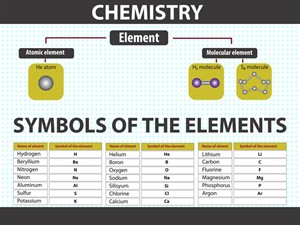
Elements and its symbols
Some elements have names derived from Greek or Latin, so their symbols may differ from their English names.
Example:
i. The symbol of iron is \(Fe\) from its Latin name Ferrum (\(Fe\)).
ii. Potassium symbol is \(K\) from Kalium (\(K\)).
iii. Sodium is \(Na\) from Natrium (\(Na\)).
Atomic number:
The number of protons in the nucleus of an atom is known as its atomic number. The symbol "\(Z\)" stands for the atomic number. The atom of a different element has a different number of protons.
We can easily calculate the number of electrons or protons in an atom if we know its atomic number.
Example: Carbon has atomic number \(6\).
Therefore,
- Number of protons = \(6\)
- Number of electrons = \(6\) (because the atom is neutral)
Mass number:
The mass number or atomic mass of an atom is equal to the sum of the number of protons and neutrons present in the nucleus. It is represented by the symbol "A"
The atomic number (\(Z\)), mass number (\(A\)), and symbol of an element are written as follows in atomic notation:
Where X is the symbol of an element.
A = Protons + Neutrons
Z = Protons or electrons
Example:
Mass number = \(16\)
Atomic number = \(8\)
By rearranging the atomic mass formula, we can calculate the number of neutrons.
Hence, the number of neutrons = \(16\) - \(8\) = \(8\)
Electrons distribution in different energy levels:
Bohr and Bury proposed the distribution of electrons in orbits.
Bohr's Model:
The definite distribution of electrons around the nucleus is called electronic configuration.
To achieve the electronic configuration, it follows a certain set of rules:
- The formula defines the total number of electrons in a shell.
Where, n is energy level or orbit number. \(n = 1, 2, 3, 4,\) etc. Therefore, the maximum number of electrons in different shells are as follows:
| Energy levels | Shells | Maximum electrons | Electron capacity |
|
1
|
K
|
\(2\)
|
|
|
2
|
L
|
\(8\)
|
|
|
3
|
M
|
\(18\)
|
|
|
4
|
N
|
\(32\)
|
Electrons fill the shells gradually in the order of increasing energy. Unless the inner shells are completely filled, electrons cannot enter the next shell. The order of filling is: \(K < L < M < N\).
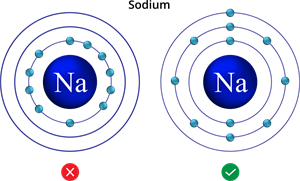
Incorrect and correct filling of electrons in sodium
Valence electrons:
The electrons that are found in an atom's outermost orbit are called valence electrons. These electrons determine the chemical reactivity and bonding behavior of an element.
Atoms are continually trying to achieve a stable state.
Stable state:
If an atom has only one shell, the stable state is achieved when two electrons are present in it. Similarly, when an atom has two shells or more than two shells, the stable state is achieved when the outermost shell has eight electrons.
A few elements such as Helium (He), Neon (Ne), and Argon (Ar) already have this configuration.
This is known as the duplet rule (for one shell) or the octet rule (for more than one shell).
The atoms that do not have this octet are involved in bond formation by gaining, losing, or sharing electrons.
i. Example for an atom losing an electron: Sodium (\(Na\)):
- Atomic number of \(Na\) = \(11\)
- Number of electrons in \(Na\) = \(11\)
- Electronic configuration = \((2, 8, 1)\)
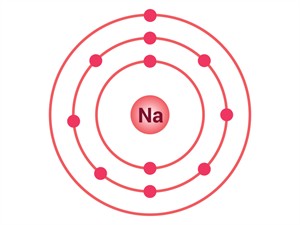
Sodium atom
To attain a stable state, sodium loses one electron, after losing one electron, its configuration becomes (\(2\), \(8\)).
ii. Example for an atom gaining of an electron: Chlorine (\(Cl\)):
Atomic number of \(Cl\) = \(17\)
Number of electrons in \(Cl\) = \(17\)
Electronic configuration = \((2, 8, 7)\)
To attain a stable state, chlorine gains one electron, after gaining one electron, its electronic configuration is (\(2\), \(8\), \(8\)).
Valency:
Valency is the number of electrons an atom can gain, lose, or share to achieve a stable electronic configuration.
The valency of noble gases or inert gases is zero since there are no free electrons in the valence shell, and the elements are already in a stable state.
Isotopes:
We observed that some elements have the same atomic numbers but different mass numbers. These are known as isotopes.
Example:
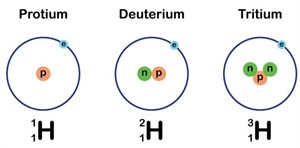
A hydrogen atom with the same atomic number but a different mass number
Most of the elements consist of a mixture of isotopes. They are pure substances. Their chemical properties are similar, but their physical properties are not.
In nature, chlorine exists in two isotopic forms (, ), with masses of \(35\) u and \(37\) u in a \(3\):\(1\) ratio. Obviously, the question that arises here is what mass of chlorine atoms we can use.
The atomic mass of a given element is a weighted average of its isotopes. Each isotope's mass is divided by its abundance.
Application of Isotopes:
- The age of fossils, fuels, and dead organisms is determined using carbon-\(14\) isotopes.
- Cobalt-\(60\) is a radioactive isotope. It decays by emitting gamma rays, which are used to destroy cancer cells.
- In the treatment of goitre, an isotope of iodine is used.
- Blood flow is traced with sodium-\(24\) to identify whether there is an obstruction.
- Uranium-\(235\) is used as fuel in nuclear reactors.
Isobars:
Isobars are atoms with different atomic numbers but the same mass number. In other words, the nucleon count is the same, but the number of protons is different.
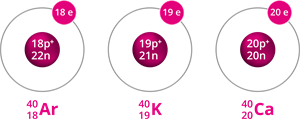
Example for isobars
Isobars are different substances, so their chemical properties are different, but their physical properties may be similar because they have the same mass.