

Some Applications of trigonometry:
The chapter 'Some applications of trigonometry' carrying weightage of 5-6 marks in the board examination. It covers the concepts like angle of elevation, angle of depressions to measure the heights and distances.
Most possible variation of question types that we can expect in board exam as per previous year question paper are discussed below:
| Total Marks 5-6 | |
| Variation 1 | Variation 2 |
Total marks = 5
|
Total marks = 6
|
To prepare well for the board examination, it is necessary to understand the following concepts clearly.
- Angle of elevation
- Angle of depression
| Important Concept(Learning Outcomes) | Expected Question Type | Concept dealt with |
| Angle of elevation - Finding anlges or side length | Sec A, Sec B | |
| Angle of elevation and depression | Sec D, Sec E |
Let us recall the concepts in applications of trigonometry:
Line of sight: The line of sight is the line drawn from the eye of an observer to the point in the object viewed by the observer.
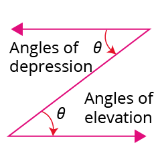
Angle of elevation: The angle of elevation of an object viewed, is the angle formed by the line of sight with the horizontal when it is above the horizontal level.
Angle of depression: The angle of depression of an object viewed, is the angle formed by the line of sight with the horizontal when it is below the horizontal level.
Common mistakes to avoid:
1. Angle Confusion: Mixing up angles of elevation and depression. Both angles are measured from the horizontal line.
2. Incorrect Diagram: Skipping the diagram or placing the given angle with the vertical instead of the horizontal.
3. Wrong Trigonometric Ratio: Choosing an incorrect ratio or confusing the opposite, adjacent, and hypotenuse sides.
4. Ignoring Observer Height: Forgetting to account for the height of the observer or building when required.
5. Unit Errors: Failing to convert units correctly or leaving out units in the final answer.
6. Misinterpreting the Answer: Forgetting that the calculated value may represent only part of the required height or distance.
7. Missing Alternate-Angle Property: Forgetting that the angle of depression equals the corresponding angle of elevation.