

In two circles of equal radii, \(AC\) and \(BD\) are common tangents drawn by joining the corresponding ends of their diameters. Verify that the quadrilateral \(ACBD\) is a rectangle.
Proof:
Let \(O\) and \(O'\) be the centres of the two circles, respectively.
The given information is geometrically represented as follows:
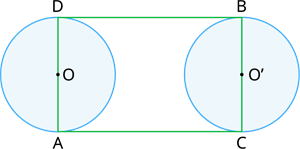
We know that, 'the tangent at any point of a circle is to the through the point of contact.
\(OA\) \(\perp\) and \(OD\) \(\perp\) .
Thus, \(\angle OAC\) \(=\) \(\angle ODB\) \(=\) \(^\circ\).
Also, \(OA\) and \(OD\) being perpendicular, \(AD\) is a .
Similarly, \(O'C\) \(\perp\) and \(O'B\) \(\perp\) .
Thus, \(\angle O'CA\) \(=\) \(\angle O'BD\) \(=\) \(^\circ\).
Also, \(O'C\) and \(O'B\) being perpendicular, \(BC\) is a .
Here, \(AD\) \(=\) as the circles are equal in .
Thus, we can say that \(ACBD\) is a quadrilateral.
It is observed that, \(\angle A\) \(=\) \(\angle B\) \(=\) \(\angle C\) \(=\) \(\angle D\) \(=\) \(^\circ\)
So, the opposite sides \(AC\) and \(BD\) are and must be .
Therefore, the quadrilateral \(ACBD\) is a rectangle.
Hence, proved.