

In \(\Delta ABC\), a circle touches side \(BC\) at \(P\) and the extended sides \(AB\) and \(AC\) at \(Q\) and \(R\), repectively. Verify that \(AQ = \frac{1}{2}(AB + BC + CA)\)
Proof:
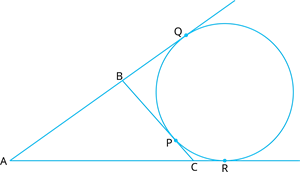
Lengths of two tangents drawn from an to a circle are .
\(BQ = \) - - - - (i)
\(PC = \) - - - - (ii)
\(AQ = \) - - - - (iii)
From (iii), we have
\(AB +\) \(= AC + \)
\(AB + \)\( = AC + \) (using (i) and (ii))
Perimeter of \(\Delta ABC = \)
By substituting and simplifying the terms we get,
\(AQ = \frac{1}{2}(AB + BC + CA)\)
Hence proved.