

Let us analyse the number of tangents drawn from a point on a circle in this article.
Case 1:
Consider a point \(O\) inside the circle.
Try to draw tangents to the circle through the point \(O\).
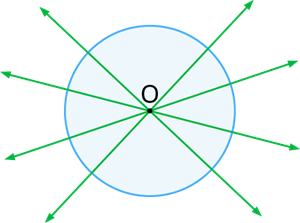
It is impossible to draw a tangent from a point inside the circle as every line intersects the circle at two points.
Therefore, no tangent can be drawn from an interior point of the circle.
Case 2:
Consider a point \(P\) on the circle.
Try to draw tangents to the circle through the point \(P\).
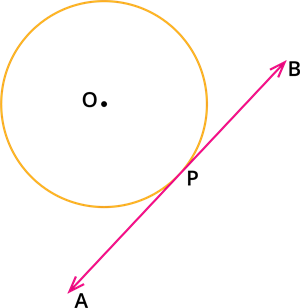
It is possible to draw only one such tangent passing through the point \(P\) on the circle.
Therefore, only one tangent can be drawn at any point on a circle.
Case 3:
Consider a point \(P\) outside the circle.
Try to draw tangents to the circle through the point \(P\).
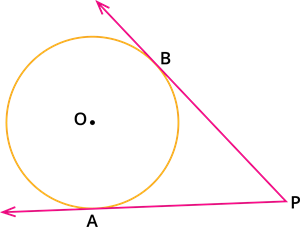
It is possible to draw exactly two tangents passing through the point \(P\) outside the circle.
Therefore, two tangents can be drawn from any exterior point of a circle.
The length of the segment of the tangent from the external point \(P\) and the point of contact \(A\) or \(B\) with the circle is called the length of the tangent from the point \(P\) to the circle.
Theorem \(2\) on circles and tangents
Statement:
The lengths of tangents drawn from an exterior point to a circle are equal.
Proof:
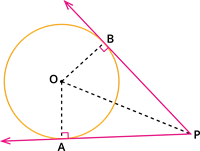
Consider a circle with centre \(O\).
Let \(PA\) and \(PB\) be the two tangents drawn from the external point \(P\) to the circle.
Construction:
Join \(OA\), \(OB\) and \(OP\).
To prove:
The tangent \(PA=\) The tangent \(PB\).
Proof:
By theorem \(1\), we have:
The tangent at any point of a circle is perpendicualr to the radius through the point of contact.
\(OB\perp PB\) and \(OA\perp PA\)
Here, \(OA\) and \(OB\) are radius. Hence, they are equal.
The side \(OP\) is a common side to the triangles \(AOP\) and \(BOP\).
Therefore, by \(RHS\) rule, if the length of the hypotenuse and one side of one triangle is equal to the length of the hypotenuse and corresponding side of the other triangle, then the two triangles are congruent.
The triangles \(AOP\) and \(BOP\) are congruent.
We know that the corresponding parts of the congruent triangles are equal.
Therefore, \(PA=PB\).
Example:
In the above figure if \(OB=3\ cm\) and \(OP=5\ cm\), find the length of \(PA\).
Solution:
By the theorem \(1\), we have:
A tangent at any point on a circle and the radius through the point are perpendicular to each other.
\(\angle OBP=90^\circ\).
So, \(OBP\) is a right angled triangle.
By the Pythagoras theorem, we have:
In a right triangle, the square of the hypotenuse is equal to the sum of the squares of the other two sides.
\(OP^2 = OB^2 + PB^2\)
\(PB^2 = OP^2-OB^2\)
\(PB^2 = 5^2-3^2\)
\(PB^2 = 16\)
\(\Rightarrow PB=\sqrt{16}\)
\(PB = 4\)
Thus, the measure of \(PB = 4\ cm\).
By theorem \(2\), we have:
The length of the two tangents drawn from an exterior point to a circle are equal.
Hence \(PA = PB\)
Therefore, the measure of \(PA = 4\ cm\).
Important!
In the above figure, \(\angle OPA = \angle OPB\) where \(OP\) is the angle bisector of \(\angle APB\).