

Consider a line segment \(AB\).
Let \(P\) be any point on the line segment which divides it into two unequal parts in the ratio \(m_{1} : m_{2}\)
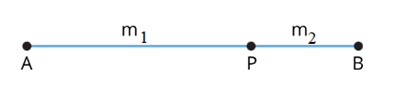
Let \(A\) be \(x_1\), \(P\) be \(x\) and \(B\) be \(x_2\) such that \(x_2 > x > x_1\).
The co-ordinate of \(P\) divides the line segment in the ratio \(m_{1} : m_{2}\).
This means, .
\(m_{2}(x - x_1)\) \(=\) \(m_{1}(x_2 - x)\)
\(m_{2}x - m_{2}x_1 = m_{1}x_2 - m_{1}x\)
\(m_{1}x + m_{2}x = m_{1}x_2 + m_{2}x_1\)
\(x(m_{1} + m_{2}) = m_{1}x_2 + m_{2}x_1\)
If \(A\), \(P\), and \(B\) has the coordinates \((x_1\), \(y_1)\), \((x\), \(y)\), and \((x_2\), \(y_2)\) respectively, then:
Special case:
The mid-point of a line segment divides the line segment in the ratio \(1 : 1\).
Therefore, the co-ordinate of the mid-point \(P(x,y)\) divides the line segment joining \(A(x_{1}, y_{1})\) and \(B(x_{2}, y_{2})\) in the ratio \(m_{1} =1\) and \(m_{2} = 1\).
Substituting the known values in the section formula, we have:
\((x,y) = \left(\frac{1 \cdot x_{2} + 1 \cdot x_{1}}{1+1} , \frac{1 \cdot y_{2} + 1 \cdot y_{1}}{1+1}\right)\)
\(= \left(\frac{x_{2} + x_{1}}{2} , \frac{y_{2} + y_{1}}{2}\right)\)