

A linear equation in which two variables are involved in which each variable is in the first degree.
It can be written in the form of \(ax + by + c = 0\) where \(a\), \(b\), and \(c\) are real numbers, both \(a\) and \(b\) are not equal to zero, \(x\) and \(y\) are variables and \(c\) is a constant.
It can be written in the form of \(ax + by + c = 0\) where \(a\), \(b\), and \(c\) are real numbers, both \(a\) and \(b\) are not equal to zero, \(x\) and \(y\) are variables and \(c\) is a constant.
Example:
\(2x + y = 8\), \(x - y - 1 = 0\), \(y = 2x\) are examples of linear equations in two variables.
We have also learnt about the solution of an equation.
A solution of an equation is a number substituted for an unknown variable which makes the equality in the equation true.
Graphical representation of pair of linear equation in two variables:
Geometrically, the linear equations in two variables will be a straight line.
So, let us know how the pair of linear equations in two variables look geometrically.
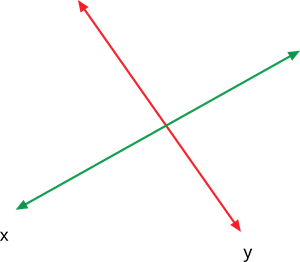
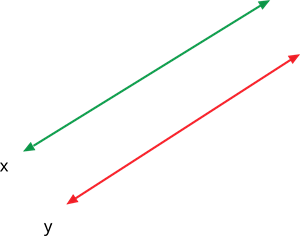
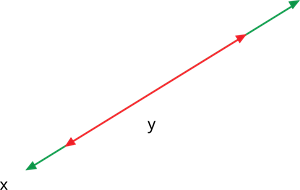
If there are \(2\) lines in a plane, then only \(1\) of the \(3\) possibilities will happen.
1. When two lines in a graph intersect at only one point, then the graph is a consistent system and has one solution.
2. When two lines in a graph do not intersect at any point, then the graph is an inconsistent system and has no solution.
3. When two lines in a graph are identical at all points, the graph is a consistent system and has infinitely many points.
Condition for the existence of solution of pair of linear equation:
Let us consider the system of linear equations in two variables.
\(a_1 x + b_1 y + c_1 = 0\)
\(a_2 x + b_2 y + c_2 = 0\)
Here, \(a_1\), \(a_2\), \(b_1\), \(b_2\), \(c_1\) and \(c_2\) are real numbers, and \(x\) and \(y\) are variables.
Now, let us see the condition for the system to be consistent and inconsistent.
1. If \(\frac{a_1}{a_2} \neq \frac{b_1}{b_2}\), then the system of equations has a unique solution. Hence, the given system of equations is consistent. Furthermore, in the graphical representation, if the equations are consistent, the lines intersect at only one point.
2. If \(\frac{a_1}{a_2} = \frac{b_1}{b_2} = \frac{c_1}{c_2}\), then the system of equations has infinitely many solutions. Hence, the given system of equations is consistent. In the graphical representation, if the equations are consistent, then the lines coincide with each other.
3. If \(\frac{a_1}{a_2} = \frac{b_1}{b_2} \neq \frac{c_1}{c_2}\), then the system of equations has no solution. Hence, the given system of equations is inconsistent. If the equations are inconsistent in the graphical representation, then the lines are parallel to each other.