

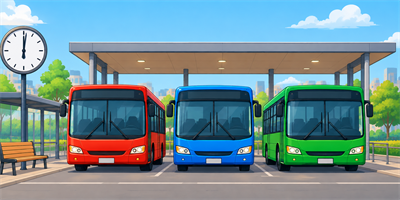
Three buses operate from the same bus station. Bus A leaves every \(18\) \(minutes\), Bus B leaves every \(24\) \(minutes\), and Bus C leaves every \(28\) \(minutes\).
At \(6{:}00\) \(a.m.\), all three buses leave the station together. The bus station operates from \(6{:}00\) \(a.m.\) to \(10{:}00\) \(p.m.\)
At \(6{:}00\) \(a.m.\), all three buses leave the station together. The bus station operates from \(6{:}00\) \(a.m.\) to \(10{:}00\) \(p.m.\)
(i) Find the HCF of \(18\), \(24\) and \(28\), and state what it represents.
(ii) After how many \(minutes\) will all three buses leave the station together again?
(iii) During the operating hours from \(6:00\) \(a.m.\) to \(10:00\) \(p.m.\), excluding the initial departure at \(6:00\) \(a.m.\), how many times will all three buses leave the station together?
(iv) The bus station wants to divide the departure intervals of Bus A and Bus B into equal time blocks of the greatest possible length. What is the greatest possible length of each time block?