

In our day-to-day lives, we often observe objects that are below our eye level, such as vehicles on the road viewed from a flyover, boats seen from a bridge, or people standing on the ground viewed from the top of a building. Measuring such heights and distances directly is often difficult.
Trigonometry helps us determine these unknown heights and distances using the concept of the angle of depression.
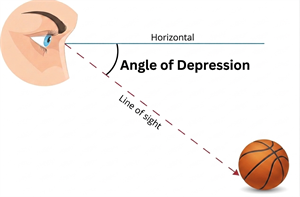
Line of sight:
The line of sight is defined as the straight line drawn from the eye of an observer to the object viewed by the observer.
Horizontal line:
The straight horizontal line parallel to the ground that passes directly through the observer's eye.
Angle of depression:
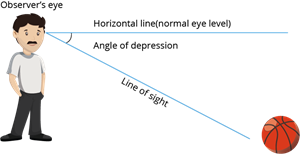
The angle of depression is defined as the angle formed by the line of sight with the horizontal line when the point being viewed is below the horizontal level.
That is the case when we lower our heads to look at the object.
Example:
A man observes the ball, which is at a distance of \(1.5\ m\) from him. If the angle of depression is \(45^\circ\), then find the height of the man.
Solution:
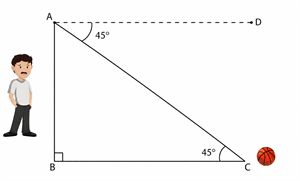
Let \(AB\) denote the height of the man and \(BC\) denote the distance of the man from the ball.
From the given data, we have:
\(\theta = 45^\circ\) and \(BC = 1.5\ m\)
To find: The height of the man \((AB)\)
Explanation:
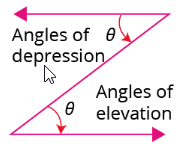
The angle of depression and the angle of elevation forms an alternate interior angles.
So, \(\angle DAC = \angle ACB\)
In the right \(\Delta ABC\) \(tan\ \theta = \frac{AB}{BC}\)
\(tan\ 45^\circ = \frac{AB}{1.5}\)
\(1\times 1.5 = AB\)
\(AB = 1.5\ m\)
Therefore, the height of the man is \(1.5\ m\)
Important!
- The angle of elevation and angle of depression are equal because they are alternate angles.
- The object is always below the observer's eye level.
- The angle of depression always lies between \(0^\circ\) and \(90^\circ\).