

The Statue of Unity situated in Gujarat is the world's largest Statue which stands over a \(58 \ m\) high base. As part of the project, a student constructed an inclinometer and wishes to find the height of Statue of Unity using it. He noted following observations from two places:
Situation - I:
The angle of elevation of the top of the Statue from Place \(A\) which is \(240\sqrt{3}\) \(m\) away from the base of the Statue is found to be \(30^\circ\).
Situtation - II:
The angle of elevation of the top of the Statue from a Place \(B\) which is \(40\) \(m\) above the ground is found to be \(60^\circ\) and the entire height of the Statue including the base is found to be \(240\) \(m\).
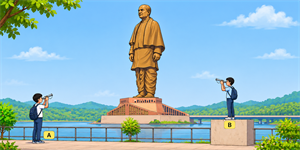
Based on given information, answer the following questions:
(i) In Situation - I, find the distance between Place \(A\) and the top of the Statue along the line of sight.
(ii) In Situation - II, find the distance between point \(B\) and the top of the Statue along the line of sight.
[Use \(\sqrt{3} = 1.732\)]
[Use \(\sqrt{3} = 1.732\)]
(iii) (a) A camera fixed at the top of the Statue records Place \(A\) at an angle of depression of \(30^\circ\). Using the distance of Place \(A\) from the base of the Statue in Situation - I, calculate the height of the Statue excluding the base and also the height including the base.
(b) In Situation - II, from point \(B\), the angle of elevation of the top of the Statue is \(60^\circ\) and the angle of depression of the foot of the Statue is \(\beta\). Identify the horizontal distance of point \(B\) from the Statue and the value of \(\tan \beta\).
[Use \(\sqrt{3} = 1.732\)]
[Use \(\sqrt{3} = 1.732\)]