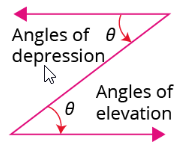
Some applications of Trigonometry problems involve both the angle of elevation and the angle of depression. In such problems, an observer is at certain height and views one object above and another object below the horizontal line of sight.
Line of sight and Horizontal line:
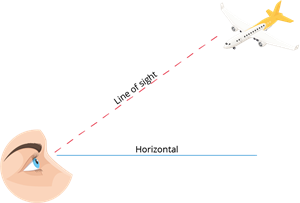
The line of sight is defined as the straight line drawn from the eye of an observer to the object viewed by the observer.
The straight horizontal line parallel to the ground that passes directly through the observer's eye.
Angle of elevation
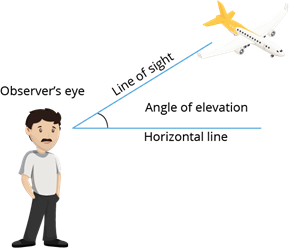
The angle of elevation is defined as the angle formed by the line of sight and the horizontal line when the point being viewed is above the horizontal level.
That is the case when we raise our heads to look at the object.
Angle of depression
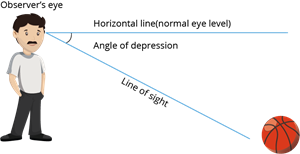
The angle of depression is defined as the angle formed by the line of sight with the horizontal line when the point being viewed is below the horizontal level.
That is the case when we lower our heads to look at the object.
Important!
- When a single problem involves both angles, it usually forms two distinct right-angled triangles sharing a common horizontal line side or a fixed vertical relationship.
- The horizontal distance between the two objects remains the same in both right triangles.
- The angle of elevation and angle of depression are equal because they are alternate angles.