

A window of a apartment is \(h\) meters above the ground. From the window, the angles of elevation and depression of the top and the bottom of another building situated on the opposite side of the lane are found to be \(\alpha\) and \(\beta\), respectively. Verify that the height of the other building is \(h(1 + tan \ \alpha \ cot \ \beta)\) meters.
Proof:
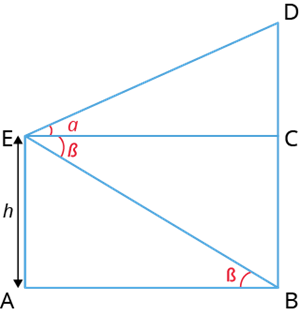
In \(\Delta ECB\)
\(tan\ \beta =\)
With respect to \(\beta\), \(EC=\) -----\((1)\)
\(tan\ \alpha=\)
With respect to \(\alpha\), \(EC=\) ------\((2)\)
From \((1)\) and \((2)\), we have:
\(DB-h =\)
Height of other building, \(BD=\)\(h(1 + tan \ \alpha \ cot \ \beta)\)
Answer variants:
\(h(1+tan\ \alpha.cot\ \beta)\)
\(\frac{DB-h}{EC}\)
\(\frac{h(tan\ \alpha)}{tan\ \beta}\)
\(\frac{tan\ \beta}{h}\)
\(\frac{tan\ \alpha}{DB-h}\)
\(\frac{h}{EC}\)
\(\frac{BD-h}{tan\ \alpha}\)
\(\frac{h}{tan\ \beta}\)