

In earlier classes, we have learnt how to find the volume of the basic solids such as cube, cuboid, cone, cylinder, sphere and hemisphere.
Let us recall the formulas to find the volume of the solids mentioned above.
|
Solid
|
Figure
|
Volume (in cubic units)
|
Formula description
|
|
Cube
|
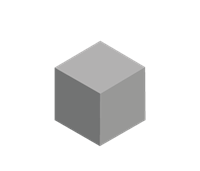 |
\(a^3\)
|
\(a\) - side |
|
Cuboid
|
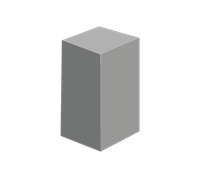 |
\(l b h\)
|
\(l\) - length
\(b\) - breadth
\(h\) - height
|
|
Cone
|
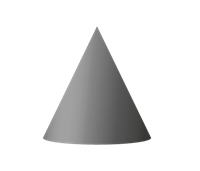 |
\(\frac{1}{3} \pi r^2 h\)
|
\(r\) - radius
\(l\) - slant height
\(l = \sqrt{r^2 + h^2}\)
\(h\) - height
|
|
Cylinder
|
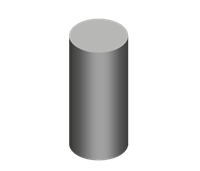 |
\(\pi r^2 h\)
|
\(r\) - radius
\(h\) - height
|
|
Sphere
|
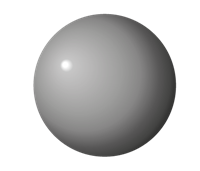 |
\(\frac{4}{3} \pi r^3\)
|
\(r\) - radius |
|
Hemisphere
|
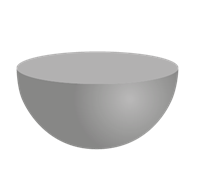 |
\(\frac{2}{3} \pi r^3\)
|
\(r\) - radius |
In our day-to-day life, we come across a wide range of objects in the form of a combination of two or more solid shapes.
Let us discuss some real-life examples in this article where we can fidn the combination of one or more solids and learn how to find their volumes.
1. Lollipop
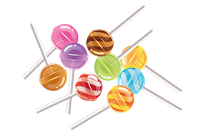
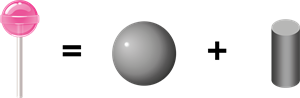
The lollipop is a combination of a sphere and a cylinder.
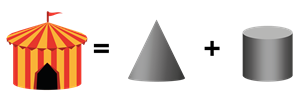
2. Circust tent

The circus tent is a combination of a cone and a cylinder.
Example:
The glass in the form of a cylinder surmounted on a hemisphere has a uniform radius of \(4\) \(cm\) and, the height of the cylindrical part is \(7\) \(cm\). Find the capacity of the glass.
Solution:
The volume of the glass \(=\) Volume of the hemisphere \(+\)Volume of the cylinder
Volume of the glass \(=\) \(\frac{2}{3} \pi r^3 \) \(+\) \(\pi r^2 h\)
\(=\) \(\left[\frac{2}{3} \times \frac{22}{7} \times (4)^3\right]\) \(+\) \(\left[\frac{22}{7} \times (4^2) \times 7 \right]\)
\(=\) \(\left[\frac{2}{3} \times \frac{22}{7} \times 64\right]\) \(+\) \(\left[\frac{22}{7} \times 16 \times 7 \right]\)
\(=\) \(134.1\) \(+\) \(352\)
\(=\) \(486.1\) \(cm^3\)
Therefore, the capacity of the glass is \(486.1\) \(cm^3\).
Important!
For combined solids, the total volume is the sum of the volumes of all the individual solids. Since volume measure the space occupied, do not subtract the common surface where the solids are joined.