

Two figures are said to be congruent if they have the same size and same shape. Two figures are similar if they have the same shape but need not of the same size.
In this chapter, we will learn about the concept of similar figures and how they are applied in real life.
A Greek mathematician Thales put forward an interesting statement regarding two equiangular triangles which is "The ratio of any two corresponding sides in two equiangular triangles is always the same".
This result is called as "Basic proportionality theorem" or "Thales Theorem".
Using an activity, let us understand the basic proportionality theorem.
Activity:
Draw any angle \(XAY\) and mark points (say \(5\)) \(P_1\), \(P_2\), \(D\), \(P_3\) and \(B\) on the arm \(AX\) such that \(AP_1 = P_1P_2 = P_2D = DP_3 = P_3B\).
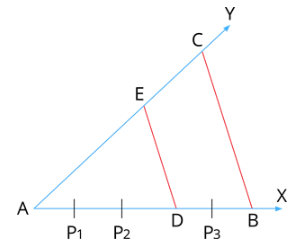
Through \(B\), draw a line intersecting the other arm \(AY\) at \(C\). Also, through \(D\), draw a line parallel to \(BC\) intersecting \(AC\) at \(E\).
Observe that, \(\frac{AD}{DB} = \frac{3}{2}\)
Also, \(\frac{AE}{EC} = \frac{3}{2}\)
Thus, in \(\triangle ABC\), \(DE \parallel BC\), then \(\frac{AD}{DB} = \frac{AE}{EC}\)
This result is proved as a theorem known as basic proportionality or Thales theorem.
Basic proportionality theorem or Thales theorem
Theorem 1: If a line is drawn parallel to one side of a triangle to intersect the other two sides in distinct points, the other two sides are divided in the same ratio.
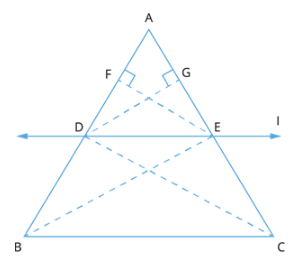
Given: In a triangle \(ABC\), a straight line \(l\) parallel to \(BC\) intersects \(AB\) at \(D\) and \(AC\) at \(E\).
To prove: \(\frac{AD}{DB} = \frac{AE}{EC}\)
Construction: Join \(BE\) and \(CD\). Draw \(EF \perp AB\) and \(DG \perp CA\).
Proof: Since \(EF \perp AB\), \(EF\) is the height of \(\triangle ADE\) and \(\triangle DBE\).
\(ar(\triangle ADE) = \frac{1}{2} \times AD \times EF\) and
\(ar(\triangle DBE) = \frac{1}{2} \times DB \times EF\)
Therefore, \(\frac{ar(\triangle ADE)}{ar(\triangle DBE)} = \frac{\frac{1}{2} \times AD \times EF}{\frac{1}{2} \times DB \times EF} = \frac{AD}{DB}\) ---- (\(1\))
Similarly, \(ar(\triangle ADE) = \frac{1}{2} \times AE \times DG\) and
\(ar(\triangle DCE) = \frac{1}{2} \times EC \times DG\)
Thus, \(\frac{ar(\triangle ADE)}{ar(\triangle DCE)} = \frac{\frac{1}{2} \times AE \times DG}{\frac{1}{2} \times EC \times DG} = \frac{AE}{EC}\) ---- (\(2\))
But, \(\triangle DBE\) and \(\triangle DCE\) are on the same base and between the same parallels \(BC\) and \(DE\).
Therefore, \(ar(\triangle DBE) = ar(\triangle DCE)\) ---- (\(3\))
From (\(1\)), (\(2\)) and (\(3\)), we have:
\(\frac{AD}{DB} = \frac{AE}{EC}\)
Hence, we proved.
Now, we shall learn the Converse of Basic proportionality theorem or Converse of Thales theorem.
Theorem 2: If a line divides any two sides of a triangle in the same ratio, then the line is parallel to the third side.
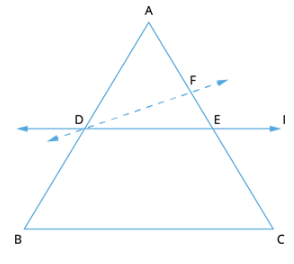
Given: A line \(l\) intersects the sides \(AB\) and \(AC\) of \(\triangle ABC\) at \(D\) and \(E\), respectively, such that \(\frac{AD}{DB} = \frac{AE}{EC}\) ---- (\(1\))
To prove: \(DE \parallel BC\)
Construction: If \(DE\) is not parallel to \(BC\), then draw a line \(DF \parallel BC\).
Proof: Since \(DF \parallel BC\), by Thales theorem, we get:
\(\frac{AD}{DB} = \frac{AF}{FC}\) ---- (\(2\))
From (\(1\)) and (\(2\)), we have:
\(\frac{AF}{FC} = \frac{AE}{EC}\)
Add \(1\) to both sides of the equation, we have:
\(\frac{AF}{FC} + 1 = \frac{AE}{EC} + 1\)
\(\frac{AF + FC}{FC} = \frac{AE + EC}{EC}\)
\(\frac{AC}{FC} = \frac{AC}{EC}\)
\(FC = EC\)
This is true only if \(F\) and \(E\) coincide.
Therefore, \(DE \parallel BC\)
Hence, we proved.