

In this section, we will recall the criteria for similarities of triangles.
Let us first recall what the similarity of triangles is.
The similarity of triangles:
A triangle is said to be similar if:
1. their corresponding angles are equal.
2. their corresponding sides are in the same ratio (or proportion).
Example:
Let us look at the two similar triangles, \(PQR\) and \(XYZ\), to understand better.
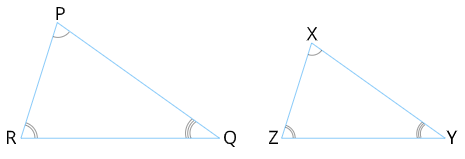
In this case:
\(\angle P\) \(=\) \(\angle X\), \(\angle R\) \(=\) \(\angle Z\), and \(\angle Q\) \(=\) \(\angle Y\).
Similarly, \(\frac{PQ}{XY}\) \(=\) \(\frac{QR}{YZ}\) \(=\) \(\frac{RP}{ZX}\)
But, should we consider equality relations of all corresponding angles and equality relations of the ratios of their corresponding sides?
We can prove the similarity of triangles with the help of a few criteria, and we can look at it in detail in the sections that follow.
SSS criteria:
If in two triangles, sides of one triangle are proportional to (i.e., in the same ratio of ) the sides of the other triangle, then their corresponding angles are equal and hence the two triangles are similar.
AAA criteria:
If in two triangles, corresponding angles are equal, then their corresponding sides are in the same ratio (or proportion) and hence the two triangles are similar.
SAS criteria:
If one angle of a triangle is equal to one angle of the other triangle and the sides including these angles are proportional, then the two triangles are similar.