

Given two triangles
\(
ABC\) and
\(
PQR\) such that
, \(\frac{
PQ}
{AB}
=\frac{
PR}
{AC}
=\frac{
PM}{
AD}
\),
where
\(AD\) and
\(
PM\) are medians. Prove that the triangles \(ABC\) and
\(
PQR\) are similar.
Proof:
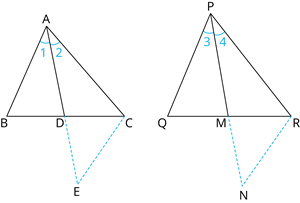
Given, that in triangles \(ABC\) and \(PQR\) in which \(AD\) and \(PM\) are medians such that \(\frac{AB}{PQ} = \frac{AC}{PR} = \frac{AD}{PM}\).
Construction : Produce \(AD\) to \(E\) so that \(AD = DE\). Join \(CE\).
Similarly, produce \(PM\) to \(N\) such that \(PM = MN\). Also, join \(RN\).
In \(\Delta ABD\) and \(\Delta CDE\),
\(AD = \) (by construction)
\(BD = \) ()
\(\angle ADB =\) ()
Thus, \(\Delta ABD \cong \Delta CED\) (by )
\(AB = \) (by ) - - - - (i)
In \(\Delta PQM\) and \(\Delta MNR\),
\(PM = \) (by construction)
\(QM = \) ()
\(\angle PMQ = \) ()
\(\Delta PQM \cong \Delta MNR\) (by )
\(PQ =\) (by CPCT) - - - - (ii)
Now, \(\frac{AB}{PQ} = \frac{AC}{PR} = \frac{AD}{PM}\)
\( = \frac{AC}{PR} = \frac{AD}{PM}\) (from (i) and (ii))
\(\frac{CE}{RN} = \frac{AC}{PR} = \frac{2 AD}{2 PM}\)
\(\frac{CE}{RN} = \frac{AC}{PR} = \frac{AE}{PN}\)
Thus, \(\Delta ACE \sim \Delta PRN\) (by \(SSS\) similarity criterion)
Therefore, \(\angle 2 = \angle 4\).
Similarly, \(\angle 1 = \angle 3\).
\(\angle 1 + \angle 2 = \angle 3 + \angle 4\)
\( = \angle P\) - - - - (iii)
In \(\Delta ABC\) and \(\Delta PQR\), we have
\(\frac{AB}{PQ} = \frac{AC}{PR}\) (Given)
\( = \angle P\) (from (iii))
Therefore, \(\Delta ABC \sim \Delta PQR\) (by ).