

In our daily life, we have read about information in the form of tables, graphs from books, newspapaers, television, etc., The information can be temperatures in cities, numbers of people living, the weight of the students studying in a school, etc.,
Data is a collection of facts or information which is used for a specific purpose.
From these obtained data, we extract certain information. This extraction of information leads to a new concept in mathematics called "statistics".
Statistics is the branch of mathematics that deals with the collection, organising, analysing and interpretation of data.
Collection of data:
Data are classified into two types. They are:
- Primary data
- Secondary data
Primary data:
The data which are collected directly by ourselves through experiments, surveys, observations, etc., are called as primary data.
Secondary data:
The data gathered from a source that has been already collected in the past by someone else is called secondary data.
Range
The difference between the highest value and the smallest value in a set of data is the range.
Example:
Consider the following set of data 2, 7, 8, 6, 10, 5, 6, 8, 2
The frequency distribution table will look like the following:
|
Number
|
Frequency
|
|
2
|
2
|
|
5
|
1
|
|
6
|
2
|
|
7
|
1
|
|
8
|
2
|
|
10
|
1
|
From the column 'Number', we know that the highest value is 10, and the smallest value is 2.
Range=Highest value−Smallest value
=10−2
=8
Therefore, the range of the given set of data is 8.
Frequency
The numerical representation of the number of times an entry repeats itself in that set of data.
Consider the above table, in which we can see the 6 is repeated 2 times.
Therefore, the frequency of 6 is 2 .
Similarly, the frequency of 10 is 1 .
The data can be presented using a frequency distribution table which we shall learn in the upcoming theories.
Construction of frequency distribution table using grouped data:
Class interval and Class size:
Class interval or classes is the difference between the upper limit and the lower limit. The upper limit is the class's highest value, and the lower limit is the class's lowest value.
The difference between the successive upper limits or the successive lower limits is called as the class size or the class width.
Example:
Let us construct a frequency distribution table for the following 26 data using tally marks.
31,32,52,60,37,49,42,56,43,55,72,84,67,75,44,41,59,57,91,98,78,66,81,88,86,58
Sol:
We can see that the data is very large, and the reader find it difficult to understand it. Hence, let us group the given data.
The minimum value is 31, and the maximum value is 91. We shall group the data as 30−39, 40−49, ..., 90−99, which are called as class intervals.
Consider the classes 30−39 and 40−49 to find the class size.
Consider the successive upper limits, then the class size =40−30=10
Now, we shall tabulate the data.
| Class interval | Tally marks | Frequency |
| 30−39 | 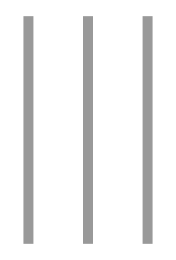 |
3 |
| 40−49 |  |
5 |
| 50−59 | 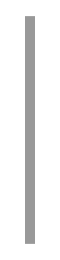 |
6 |
| 60−69 | |
3 |
| 70−79 | |
3 |
| 80−89 | 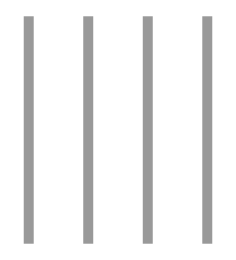 |
4 |
| 90−99 | 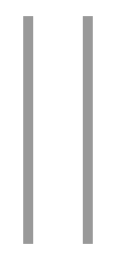 |
2 |
This table is called a frequency distribution table using grouped data.